

What Is Share of Voice and How Does It Apply to AI Search

Share of voice measures a brand’s slice of a competitive conversation. AI search changes where that conversation happens and what counts as being heard. Measuring it means tracking whether answers name a brand, cite its content, and give it a strong position across repeated prompts and different models. Rankings and clicks cannot answer those questions.
Why share of voice exists and what it has always measured
Share of voice has always measured how much of a competitive conversation belongs to one brand. In paid media, the measure was ad impression share. In earned media, it was coverage volume or mentions. In organic search, it became the share of clicks across keyword rankings. The underlying logic stayed the same, which was to measure the slice, compare it with competitors, and work to grow it.
That consistency gave the metric value without making its measurement method universal. SEO teams tracked ranking share, teams in paid media tracked impression share, and PR teams counted mentions. Each instrument suited the channel where the competition happened. A new discovery channel therefore calls for a new instrument to measure the same concept.
How AI search creates a structurally different competitive conversation
An AI-generated answer changes the unit of competition. A brand on page two of traditional search still holds a ranking, even if few people reach it. In an AI answer, the brand is either named in the text or absent. There is no partial ranking credit for a name the answer leaves out.
With that difference, strong Google rankings need not mean strong AI visibility. AI systems retrieve and synthesize material, and the sources they draw on differ by platform. A brand can receive extensive media coverage yet have no share of an answer if those publications are outside the sources an engine draws on for that commercial question. Coverage volume and AI citation share are therefore separate measures. One cannot stand in for the other.
BrightEdge sees AI mainly as a discovery channel, where people ask questions and learn before they convert through organic search or direct visits. Google still commands the overwhelming majority of search traffic, and the argument is that the shortlist can take shape before the click. A brand can compete well for search traffic and still miss that earlier conversation.
What AI share of voice actually measures — the three sub-metrics
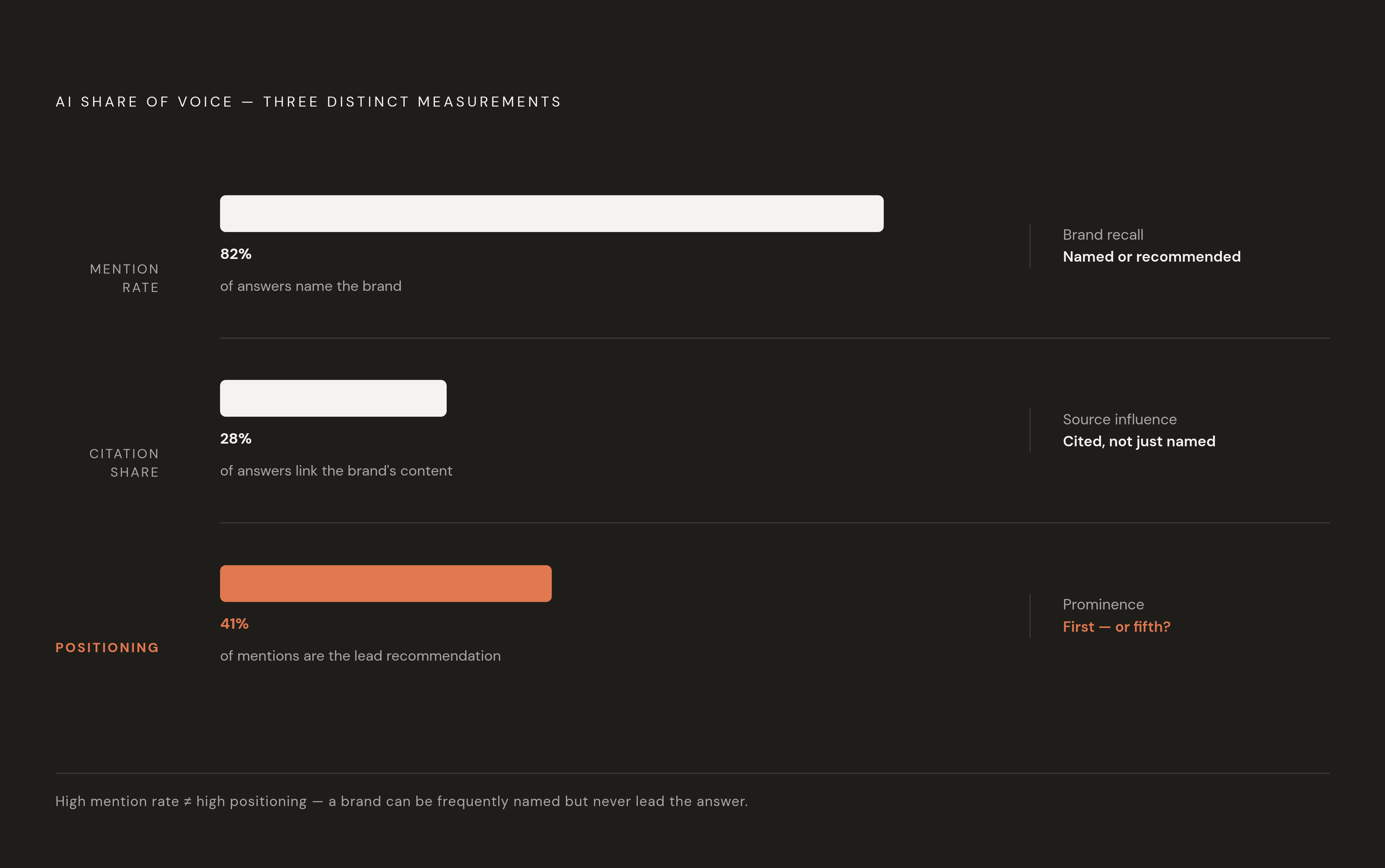
AI share of voice measures a brand’s presence in answers across a defined set of category prompts. Its competitive share can be calculated as brand mentions divided by total brand mentions, multiplied by 100. A citation-based version uses the number of brand citations divided by total citations, multiplied by 100. But a measurement system needs to track three things on their own: mention rate, citation share, and positioning.
Mention rate captures how often the answer names or recommends the brand, whether or not it links to a URL. This entity-based measure is especially relevant to prompts asking for recommendations, the best options, or top providers. It reflects the model’s association between a brand and a category. The percentage of responses that name a brand and its share of all brand mentions have different denominators. The score needs to say which one it reports.
Citation share measures how often the brand’s content is linked as a source. It matters particularly for explanatory, how-to, and comparison answers that combine material from several references. A brand can be frequently recommended without its content being cited, or frequently cited without becoming a recommendation. Measuring both separates brand recall from influence as a source.
Positioning adds the distinction between leading a recommendation and appearing in passing. Being named first has a different value for the business than appearing fifth, even though both count as mentions. A position-weighted score captures that distinction, while a raw mention count does not. Teams should choose and disclose the formula that matches their objective. A single number labeled AI SoV, without that qualification, is incomplete.
Why the same prompt returns different results — and why that breaks single-point measurement
Even a precise definition cannot make one answer representative. Large language models use probabilities to choose the text that comes next, so the response is not fixed. The same prompt can therefore return different brands on different runs. A favorable answer establishes only that a brand can appear. Whether it appears consistently or alternates with a competitor matters.
The response is to measure a distribution across repeated runs and sessions. That means counting which brands appear despite changes in wording. Repeating a defined prompt panel provides evidence about the pattern. One run supplies a reading, while repeated runs support a score. Without that distinction, ordinary variation can look like a competitive gain or loss.
Time adds another source of movement because cited domains can change even when the brand takes no action. A previous month’s result may not describe the model’s current answers. An audit each quarter cannot take the place of tracking results over time. Manual prompting can give a team an initial orientation, but it cannot provide dependable trend data at scale. Scheduled measurement is the necessary step from checking answers to tracking a market.
How each AI engine surfaces brands differently and why that demands per-platform tracking
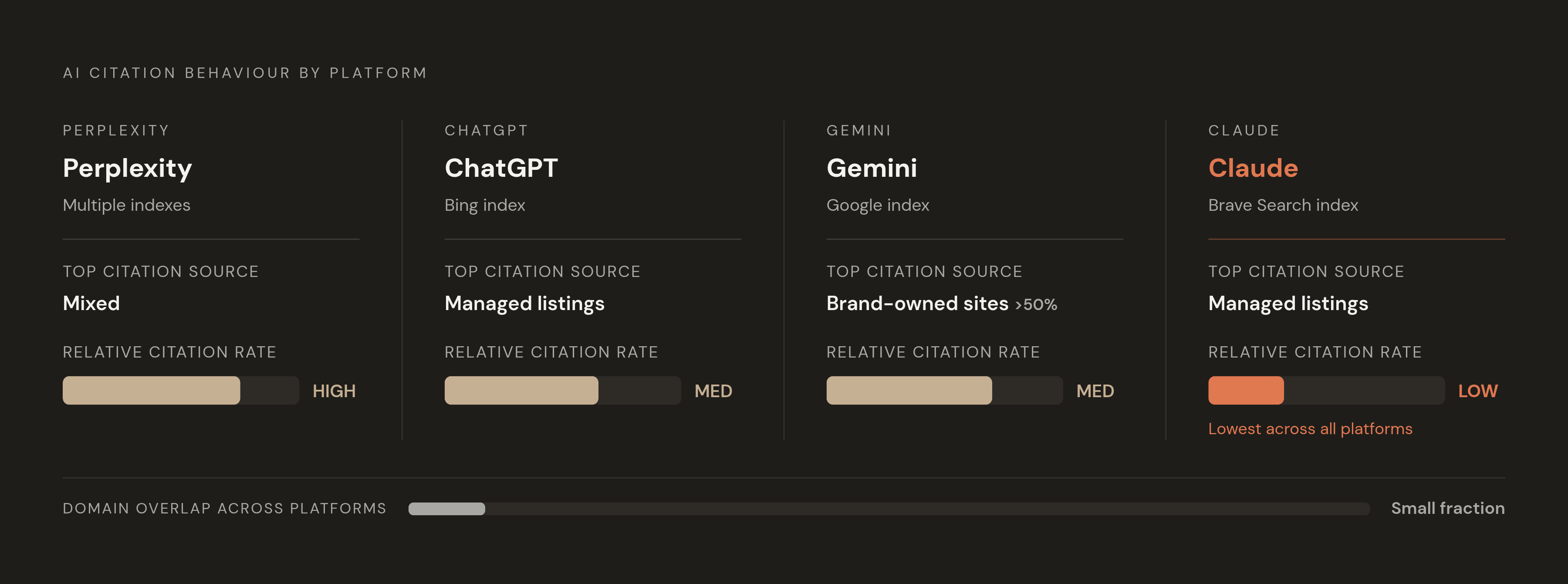
Repeated measurement also needs to account for which engine produced the answer. ChatGPT uses Bing as its primary web index, Claude uses Brave Search, and Gemini draws on Google’s own index. Those different starting points help explain why identical queries produce different cited sources. Only a small fraction of cited domains overlap across platforms for the same queries. A strong result on one engine is not evidence of a strong result on another.
Yext’s Q4 2025 research shows that the source mix differs as well. Gemini draws a majority of its citations from brand-owned websites. Claude draws a smaller share from those websites than Gemini, and its largest source category is managed listings. ChatGPT also draws its largest share from managed listings.
Citation frequency adds another distinction. Claude has the lowest citation rate across the same brand and buyer-question set when compared with Perplexity, Gemini, and ChatGPT. A brand could consequently have strong citation share on Gemini and near-zero share on Claude without a change in its content quality. That gap needs interpretation within each platform. A score that blends the engines can hide where a brand is weak against its rivals.
Google’s API documentation says Gemini’s grounding connects the model to real-time web content, but ChatGPT also offers real-time web search. Access to recent information does not by itself establish which engine will favor a brand. The practical requirement is narrower and firmer. Track each engine on its own before using a score that combines them.
Why sentiment and positioning inside an AI answer matter as much as mention frequency
An appearance is not automatically a win. An answer can present a brand as the solution, place it among alternatives, reuse its content without credit, or omit it altogether. Each state has a different commercial meaning. Even when a mention is counted, leading the recommendation is not equivalent to following a competitor.
An answer that says “Brand X is an option, though users report reliability issues” records a mention while damaging consideration. A frequency score alone could treat that as an improvement over absence. The measurement would be technically consistent but commercially misleading. Sentiment and prominence prevent that false positive.
AI sentiment is distinct from social listening because its subject is the answer engine’s advice, while social listening concerns public discussion of the brand. It examines how the model describes, compares, recommends, or ignores a company when a buyer asks for help. Classifications include positive, neutral, negative, comparative, and absent. Comparative language deserves its own attention because it positions the brand against another option. A neutral-sounding mention can still leave a rival as the clear recommendation.
Yext’s 2026 Consumer Search Behaviors Report finds that nearly all AI users check at least one thing before acting on a recommendation. That makes the framing relevant beyond the answer itself. Positive prominence can support trust during verification, while negative framing can undermine it. A complete score therefore records how the brand appears as well as how often it appears. Without that detail, a brand may get more mentions while falling behind its rivals.
How to design a prompt panel that produces a valid AI SoV score
The prompt panel is the foundation of the measurement system. It should use the questions buyers ask as they weigh solutions, in the words buyers use. Repeating the wrong questions more often only makes the wrong measurement more consistent. The panel should have informational, comparison, and purchase-intent prompts because each shows a different way a brand can appear. Its mix should follow the measurement objective.
That mix is not neutral. Words such as “best,” “trusted,” “recommend,” and “reliable” increase the likelihood of brand mentions. A panel weighted toward recommendations can therefore produce higher mention rates than one dominated by informational questions. Either can be valid, but they do not measure the same thing. The prompt composition needs to remain part of the score’s meaning rather than disappearing behind the headline percentage.
Changes in word order, specificity, and framing can reveal whether a brand appears broadly or only under narrow conditions. Repeated runs test how much the answer changes, while prompt variants test how much it changes with the question itself. Both matter because a brand that appears across varied phrasings has more durable visibility than one dependent on an exact wording. The panel should then run across all relevant platforms.
Continuity turns that panel into a competitive instrument. A first run establishes a baseline, while weekly or more frequent runs produce trend data. Consistent benchmarking requires the same panel and competitor set over time, so changes in the test do not masquerade as changes in performance. At scale, scheduled automation makes that repetition manageable. A well-designed panel run systematically across models turns AI SoV from an impression into a trackable metric.
How AI SoV fits alongside existing search and brand metrics
AI SoV belongs in the measurement stack because it answers a question existing metrics cannot reach. Organic rankings show how visible a brand is in search, while AI SoV shows whether it is part of the discovery conversation. Strong rankings with low AI SoV can mean a brand is positioned to capture a click but absent from the shortlist that precedes it. High AI SoV with weak organic presence creates the opposite gap. The measures complement each other rather than compete for ownership of the buyer journey.
The same relationship connects SEO, AEO, and GEO. SEO provides the foundation through indexed, authoritative pages. AEO structures content so AI systems can extract and attribute it as answers. GEO goes further to cover how much influence a brand has across generative AI systems. AI SoV is the competitive measurement instrument for that broader layer, showing whether visibility and influence are changing.
Building that instrument now gives teams a baseline against which later changes can be judged. Waiting leaves no steady record of how the brand did earlier, and a few checks later cannot fill it in. The infrastructure also raises a practical ownership question because repeated multi-model queries incur API costs and generate data. Those costs and outputs should remain under the brand’s control.
Lettertrace provides a concrete implementation of that approach. It automates prompt variation, multi-model querying, and aggregation into trends, while tracking visibility, share of voice, prominence, and sentiment by topic and model. It is MIT-licensed, self-hostable, and bring-your-own-key, with user-owned Supabase storage, no usage markup, and no vendor lock-in. Those features address the operational burden without requiring the brand to surrender its data. The goal remains straightforward, which is to measure a competitive conversation consistently enough to know whether the brand’s share is growing.