

Why Competitors Appear in AI Search Results More Than You Do
ChatGPT alone fields over 2 billion queries a day, and a growing share of those end with a shortlist: two or three brands, named out loud. Brands missing from that shortlist are quietly losing sales, because people never reach a search page where they might have seen them. Here’s why it occurs, plus what separates brands that make the shortlist from those left out.
The AI referral market is fragmenting, which means a competitor's advantage on one engine is not the whole picture
A single AI tool drove 89% of trackable B2B AI visits eight months earlier. By then, it was down at 62.6%. Claude rose to 18.5% in that period, up from 1.4%. Gemini climbed 10.6%, Perplexity gained 7.3%, Copilot stayed close to 4%.
On desktop, Google's AI Overview shows the same pattern. It climbed from 25.8% of July 2025 searches to 39.4% in June 2026. Bing's Copilot Search rose, 11.8% to 17.3%, in that same period.
Reading a single engine's rank as if it represents the rest loses the most ground today. A company can rule ChatGPT's responses and be invisible on Claude. It can show up consistently on Gemini and disappear across the rest. Each system draws on its own index and weighs its own corroborating sources, with its own rules for who appears. Tracking only ChatGPT is tracking a shrinking portion of a space now splitting five directions.
Why strong Google ranking does not translate to placement within AI-generated answers
73% of brands with zero mentions in AI-generated answers still rank on Google’s first page. A personal injury law firm holding the #1 organic spot on Google for "personal injury lawyer Miami" got zero mentions when the same query ran through ChatGPT. Number-one slot, nothing to show.
You can explain that difference by checking where AI Overviews pull their answers. A large share of citations in AI Overview come from URLs outside the top 20 organic spots for that query. AI systems read from a different pool of sources than the one traditional SEO spent two decades building a leaderboard around, and assuming the two leaderboards overlap is where most brands lose the thread.
In classic search, on-page relevance and links matter. AI engines value different signals: freshness, corroboration from third-party sources, extractability (can software pull clear details from your content), and consistency in a brand’s presence across sources. Ranking on the first page of Google reveals none of them.
The signals that decide which brands show up in AI answers, and how competitors who nail them pull ahead
Freshness is the strongest factor, and it turns on or off instead of building gradually. Pages not changed in 90 days get their citation dropped far more often. Just 30% of brands stay visible between two AI answers on the same subject, with a mere 20% holding across five straight queries. For SaaS, finance, and news content tied to buying decisions, that window shrinks further: pages not updated quarterly are far more likely to lose citations. A company that updates its pages quarterly builds an advantage no rank tracker can capture.
How a page is built counts too, and it’s not about looks. Pages that use sequential headings and schema markup see substantially more citations than messy ones. When ChatGPT cites pages, 68.7% of them follow a structured hierarchy, and 87% use just one H1. Models have to scan quickly, grab the fact, and keep going. When a site has mixed-up headings, or H1 tags scattered across six spots, facts come out too slowly, so the system skips it for a cleaner one, even when the content is thinner.
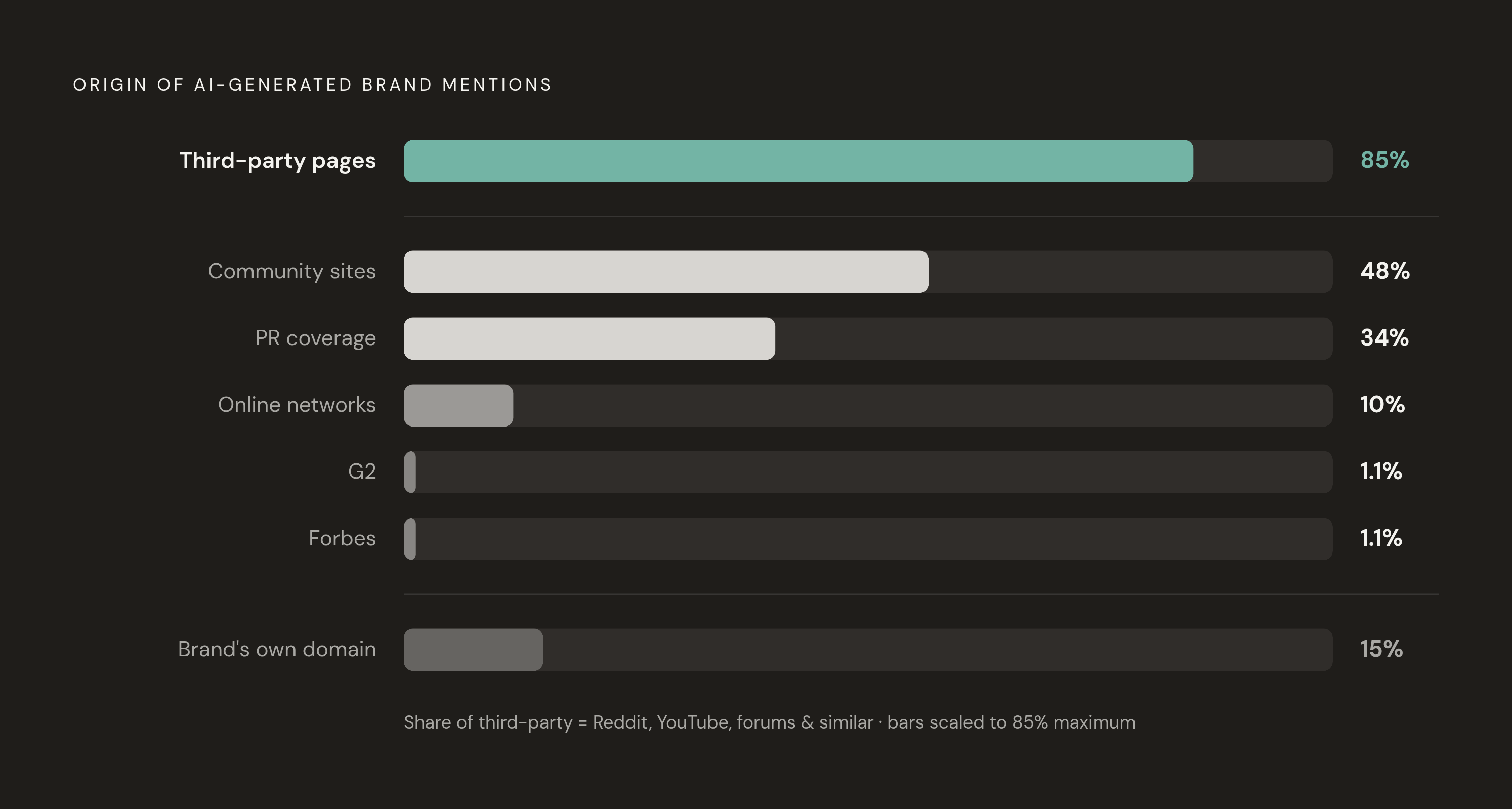
No volume of owned content can rival Off-site credibility as the key lever a competitor has. In AI answers, 85% of brand mentions trace to third-party pages rather than the brand's own domain. About 48% come from community sites such as Reddit and YouTube. PR-driven coverage accounts for 34%, online networks for 10%. G2 and Forbes each account for 1.1%. When a brand has people talking on Reddit, plus G2 reviews and earned coverage, it builds a citation footprint its own site can't beat.
Budgets often overlook consistency, the hidden threat. Models lean on details that appear identically across their source material. When Yelp, the business's Google Business Profile, its website, or third-party directories show inconsistent days open, rates, or positioning, the mismatch does more than confuse buyers. That erodes what the model's sure of, so it leaves the brand out. A brand with the same positioning on G2, Reddit, industry forums, and Capterra looks corroborated. If the signals conflict, it gets hedged, watered down, or dropped.
How Gemini, Claude, and ChatGPT pick a brand
All three lean on shared trust, with writeups, reviews, and chatter all pushing the same positioning. Beyond that instinct, they quickly diverge, and seeing them as interchangeable is how brands lose position without realizing it.
ChatGPT draws on its own index, usually surfacing brands that earn high-frequency mentions through third-party sites, aggregators of reviews, and comparison posts with lots of links. Its citation style can make tracing the reason a brand appeared less clear than on Perplexity, where sourcing is visible. Getting mentioned often across many sites, not just one big one, usually pays off here.
Claude leans mostly on earned reach and organic credibility, indexed mainly through Brave Search. Claude often presents suggestions with qualifiers, and it values corroboration from multiple sources, so consistent positioning across Reddit, G2, Capterra, and industry forums can strengthen trust. A brand can perform well here with strong third-party positioning.
Gemini draws on its own index, which includes many of the same signals Google uses. Structured markup, a full Google Business Profile, plus solid Google-indexed visibility create a Gemini-specific advantage that won't transfer to other engines.
Share of voice in AI answers is the metric that makes competitor gaps concrete and trackable over time
AI visibility shows how often a brand gets mentions across answers generated by AI, compared with its competitors. This comes from credibility built gradually on outside websites, making it difficult to lose once achieved and even harder to recover once gone.
The math is simple. Ask the same list of relevant questions to each AI, note how often the company comes up, then convert that into a percentage using 100. It typically takes multiple prompts before the figure stabilizes.
The figure only makes sense with what's around it. Most brands land in a visibility range between 25% and 40%. A score above 40% indicates strong visibility, and few brands exceed 60%, since AI tools diversify sources instead of picking one every time. Brands that track their AI citation footprint usually show up in under 30% of category queries, no matter how high they rank in standard search. The divide from search rank to AI visibility is the place competitors pull ahead with no one noticing.
How Lettertrace turns systematic checks into an ongoing habit instead of a one-off
Typing just a few ChatGPT prompts monthly gives a snapshot, and one that goes stale fast. With brands stay visible in just 30% of same-topic answers, one look shows very little. Visibility changes with every query, so a snapshot misses what's happening. It calls for regular tracking, not sampling when a person remembers to check.
A good system watches a few things at once: if the brand comes up, how strong that mention is (an exact line counts more than a brief one), which competitors appear next to it, the source of the citation, and how favorable it sounds. That whole setup needs to cover different prompt phrasings across engines, because people research a category in more than one way. Buyers type informational, comparison, and recommendation queries within one sitting, so any lone prompt formulation misses how that actually unfolds.
Tracking tools have multiplied quickly, and each one focuses on its own area. Frase monitors ChatGPT, Google AI, Perplexity, Claude, and Gemini, with coverage tiered by subscription (Starter gets Google AI and ChatGPT, Professional is where Perplexity unlocks, while Scale adds Claude and Gemini). The AI Visibility Toolkit fits those already using Semrush. AthenaHQ serves scaling SaaS firms needing GEO data from top platforms. SE Ranking suits SEO groups looking to keep AI visibility alongside their current search data. Positive Surfer is built for content groups already optimizing in Surfer.
Lettertrace belongs in this category: ongoing tracking of how brands are mentioned across engines, not a one-time review that goes stale as soon as the answers change. Brand presence shifts, freshness spans are still tightening, while citation sources rotate beyond any quarterly review. Steady tracking catches a competitor's edge before it becomes a lost sale that was never in the funnel.
Sources
- The 2026 State of AI Search: How Modern Brands Stay Visible
- 10 Best AI Visibility Tools in 2026 (Compared + Free Checker) | Frase
- AI Search Trends for 2026 & How You Can Adapt to Them
- What Influences Brand Visibility in AI Search? A Practical Guide for 2026 - Onely
- https://www.advanced-television.com/2026/09/23/report-claude-and-gemini-gain-ground-on-chatgpt/
- https://writer.com/blog/geo-aeo-optimization/
- https://liatbenzur.com/2026/04/22/how-chatgpt-gemini-claude-grok-and-perplexity-decide-which-brands-to-recommend/
- https://houseofmartech.com/blog/how-chatgpt-gemini-and-claude-each-decide-which-brands-to-mention