

Building a Competitor AI Benchmarking Cadence

Creating a Competitor AI Benchmarking Cadence.
Why AI answers have become a brand visibility surface that demands systematic measurement
AI answers have become the place where Brands get found, explained, or distorted long before a visitor clicks to the real page. That shift sets this piece’s pattern: ChatGPT and Gemini, along with Perplexity, now come first, with search results after them.
Those figures are too big to dispute. Reuters said ChatGPT hit 900 million weekly active users at the start of 2026 and hit 1 billion active users per month by June. Gemini's alone drew 750 million monthly users, while Google's AI Overviews covered 2 billion users a month. These tools have become mainstream. More people are beginning their research there.
In 2026, Moz reviewed almost 40,000 queries and learned 88% of citations in Google's AI Mode were from pages outside the organic 10, a worry for those still treating rank as their key signal. A strong Google ranking tells a brand almost nothing about showing up when an AI assistant gets asked the same thing. Conductor's co-founder Seth Besmertnik framed it in January 2026: AI hasn't ended search, it's taken the site's place as the opening touchpoint. It's a meaningful distinction, not just talk. Search still exists. It just doesn't start at a homepage anymore.
This tracks with what buyers actually do. About 73% of B2B buyers check vendors with tools such as Perplexity and ChatGPT before they reach a company's website. So a real slice of every purchase call is taking shape from how AI describes a brand, yet most organizations can't see what those answers even contain.
This is the gap. Unless a brand keeps querying these engines on purpose, it can't tell how it's being shown, or if it shows up at all. Because AI answers shift with the prompt, across platforms, and over time, one test tells almost nothing. A single positive hit today guarantees nothing for the days ahead. The case here is for an automated system that checks on a set cadence rather than occasional spot-checks that hope nothing has changed. AI search visits rose 42.8% from Q1 2025 to Q1 2026.
What a competitor AI benchmarking cadence actually is
Here, a cadence is just a repeatable operational workflow: set prompts, a regular interval for them, and steady scoring of the responses. It's infrastructure with a repeatable cadence. It's infrastructure.
What doesn't count needs a clear definition. Asking ChatGPT "do you know my brand?" every few months is no cadence, it's curiosity. A competitive review built one time, dropped into slides, and forgotten doesn't qualify either. And checking only one platform fails the test, because separate engines surface separate brands for the same prompt, a point this piece covers later.
A cadence rests on several pillars: a prompt set that stays steady and doesn't drift over time, a regular measurement interval, consistent scoring across sentiment, visibility, and competitive presence, plus a structured way to compare results against specific competitors rather than tracking one brand alone.
A spreadsheet is a perfectly good place to start, not a fallback. Ryze's 2026 benchmarking holds up: the process matters more than the tool. A misconfigured paid platform yields less reliable results than a disciplined spreadsheet. The DIY process means choosing 3 to 5 competitors, writing prompts for a few query types, using each prompt repeatedly, logging every citation and mention, then calculating baseline figures from that record. That baseline sets the zero mark. Every later measurement gets judged against that baseline, so getting it right up front affects how accurate every subsequent reading turns out.
The spreadsheet approach breaks down when volume grows. Running Manual API queries on a weekly cadence turns unsustainable as volume grows, and it stops working pretty soon. This is when automated tooling begins to pay for itself, something the tools piece digs into directly.
Building the prompt set that defines what you are measuring
Prompt design matters most to whether a cadence works or breaks, above the tool or platform tracked. AI visibility hinges on the prompt: a firm might top "best PR software 2026" yet vanish when users ask how to measure earned media ROI, even though both queries fall into the same category. Track the poor prompts and the numbers seem strong but ignore the real gap.
Volume has a hard lower bound. Fewer than 15 prompts and single-response variation starts dominating the results, making the data more noise than signal⟧c18⟧.
Every set needs these prompt categories. Brand queries (something like "what does [company] do") test straightforward recognition. Category queries ("best [category] tools 2026") show how a brand sits within the wider industry dialogue. Comparison queries ("[brand] vs [competitor]") reveal the system’s head-to-head framing. Problem queries, the "how do I…" style questions, test whether a brand gets associated with the actual task a buyer is trying to solve, not just its own name.
Discovery layers, rival options, use-case prompts, and transactional archetypes add breadth. Scoping matters more for reliability than breadth. When a built prompt list is poor, the score can seem much too high or low, while Ryze's assessment of a single prompt-tracking tool stated plainly: results match the prompt library fed into platform.
Don't constantly tweak the list. Add prompts gradually, and consistency at the start preserves week-over-week comparisons intact; swapping prompts mid-cadence breaks comparisons across releases. Leave branded searches out by default. Most of the set should run on category and comparison prompts, not "share what [my brand] is about," because branded prompts inflate every figure and blur the true competitive picture. Prompts built around terms taken from niche forums and Reddit threads bring another layer, because AI seems to lean hard on those discussions, while a prompt set built around brand-centric ideas alone can leave the gaps in forums unseen. Most audits run 30–50 prompts; sticking to 20–35 tied to clear archetypes yields solid signal without bogging analysis down (PromptEden, 2026).
The metrics that convert raw AI outputs into competitive intelligence
AI share of voice underpins every metric that follows. It's straightforward: in a category, when a brand shows in 28 of 100 relevant AI-generated answers, the brand's AI SOV comes to 28%. It captures if a brand shows up, and how frequently it beats competitors across that query set. Unlike conventional advertising benchmarks, AI SOV cannot be purchased outright. No media spend guarantees a mention.
People treat them as the same, but they're not. A mention happens when the brand's identity shows in any part of the reply. A citation is when the model links directly to the brand's domain. They're measured separately, and gains in one won't necessarily lift the other. A brand might show up often but get cited only rarely, or the opposite.
Counting mentions skips what really counts too: tone and placement. A negative AI mention hurts more than no mention, because the way a brand is recommended matters as much as the mention itself. Where a brand sits in the reply matters too.
None of this matters without a competitor comparison across the same prompt set; raw results alone tell little until measured against a rival's.
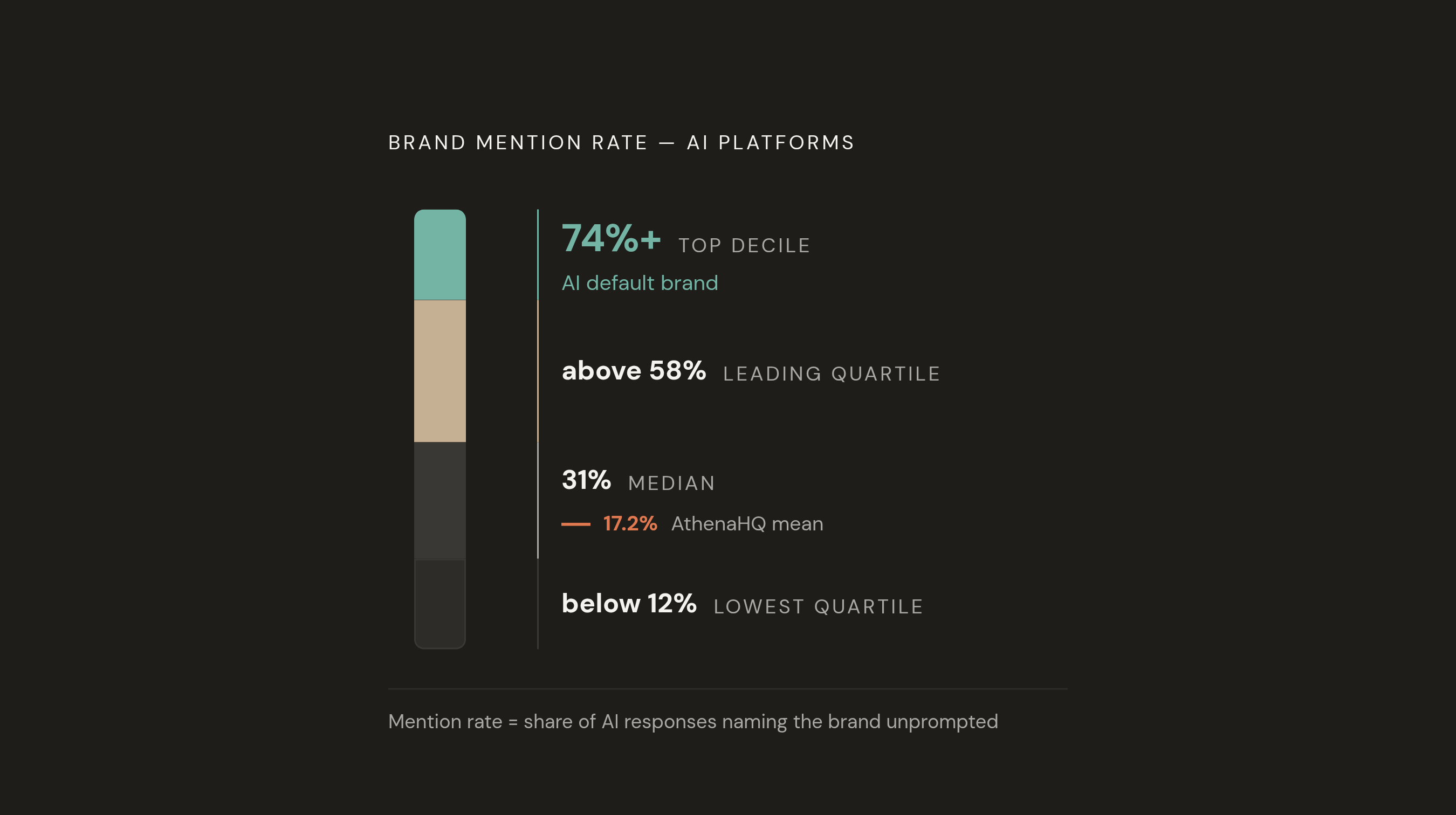
A few benchmark figures put a brand's standing in perspective. MaxAEO ran a mid-2026 panel tracking several hundred brands on eight engines, reporting a median non-branded mention rate of 31%; the leading quartile passed 58%, while the best decile, those brands AI treats as its default, reached 74% or more, and the lowest quartile fell below 12%. AthenaHQ's State of AI Search 2026 report put the mean brand mention rate at only 17.2%, underlining the size of the gap between visible brands and those that stay invisible. In May 2026, Mentionable's numbers revealed the leading performers in a category held 40-60% share on their target prompts, appearing across more than 70% of relevant ones.
The distribution tells something important. Climbing out of invisibility toward the median comes down to cleaning up entity clarity and crawlability so the brand gets identified and indexed properly. Reaching category leadership from the median is a harder citations challenge, and that shift calls for something entirely different.
Why each AI platform surfaces different brands
Each platform has its own index, shopping and infrastructure stack, and signals for ranking, so optimizing one doesn't translate to another. Among the major engines, ChatGPT offers the widest citation reach, but it usually paraphrases instead of naming origins unless SearchGPT is explicitly triggered, so tracking citations on that platform is genuinely harder. Perplexity, instead, builds clickable links by default into its answers, making it more traceable and the one to be prioritizing in industries where credibility matters. Gemini leans harder on SEO signals like domain rank, backlink counts, and E-E-A-T than other AI engines do, plus it needs entity clarity, semantic relevance, and structured markup, so its different overlap with organic search results stands out.
The overlap alone tells the story. Perplexity cited just 11% of the domains that ChatGPT cited. points to a wide gap between mostly distinct universes. The same brand can see a 20 to 40% swing on the same prompt purely based on the platform.
The real problem: a brand comfortably ahead on ChatGPT might be absent from Perplexity, whereas a competitor invisible on one tool dominates the other. Track only one platform, and what comes back on competitive standing isn't incomplete, it's false. Each one acts as a consensus builder, pulling together which brands seem credible from many sources instead of rewarding a well-built landing page. That determines where the real optimization work should go.
Setting the measurement interval
Everything else in the cadence builds on those daily pulls. One query checked once reads more like noise than evidence, and each rate should be averaged over repeated runs, because AI answers shift beyond what teams first think. The practical rhythm: check each day, share the numbers weekly. It smooths short-term jitter but stays sensitive to notice a genuine shift when one comes. Do a complete measurement pass at least weekly or every other one, because models refresh their training data regularly and competitor updates can shift visibility quickly.
Not everything that shows up is a real signal. Under a third of brands keep consistent visibility between runs of the same platform, so much of that variation is just these tools acting normally, not something to chase. A shift of a few percent with no clear reason: ignore it. When a change holds the same way for 3 or more straight weeks, start digging. If a sudden shift matches a competitor's PR move or publishing effort, look into it and maybe act.
Switching the measurement timing partway through breaks comparability just as much as swapping out the prompt list. Choose an interval and stick with it. The weekly note, done consistently, connects whoever does the queries with whoever plans direction: what changed, which competitor caused the shift, and the reason.
Tooling options for running a competitor AI benchmarking cadence at scale
The spreadsheet approach has a limit, and that limit sits somewhere exact. Run it weekly and manual API requests stack up beyond 600, where the workflow becomes impossible to maintain. At that point, an automated platform is worth the money.
Every tool in the category needs to meet a few criteria. How many of the major engines does it cover? Can it tell which prompts lead to a mention, and which competitors appear with the brand there. Does it build a competitive comparison from the data, or only chart the brand's own history. Does it tell good calls from bad, or just tally every brand mention the same? Does it identify which pages are pulling citations, giving the team a clear target for upcoming content? And does it tie tracking to a real workflow, or just give back a dashboard and make people figure out the next steps.
A few tools handle different pieces of this list. Frase follows ChatGPT, Perplexity, Claude, Gemini plus Google AI, linking that view to a broader work cycle for ideation, drafting, optimization, and release, for teams needing to find a gap and handle it in one workflow, with plans from Starter through Enterprise. Broader enterprise-scale vendors are built for big companies needing compliance and depth, pairing multi-engine tracking with analytics that run from self-serve plans up to enterprise deals. Certain platforms work across many engines, built for enterprise teams using big prompt libraries, making tracking and citation their main focus, though results hinge on whether the prompt list is well-researched. AthenaHQ monitors a large set of engines for enterprise teams and mid-market buyers who need deeper generative-engine-optimization analytics, built around a working hub instead of a static dashboard, showing self-serve rates. Surfer’s Positive Surfer tracks major engines, folds the tracking into its existing optimization tool, and costs $49 per month, billed yearly, with a separate AI visibility tier.
These tools can't stand in for prompt design or interval habits laid out above. They only make that framework scalable once the spreadsheet stops keeping up. Semrush AI Visibility Toolkit covers multiple engines and AI Overviews; tracking sits inside the wider Semrush SEO platform; aimed at teams already on Semrush; standalone is $99/mo per domain, or about $165.17–$165.83/mo billed annually through the Semrush One Starter bundle (Frase, updated September 2026). SE Ranking: tracks Google AI and certain chatbots within an SEO platform, starting at $103.20/mo billed annually with an AI Search add-on (Frase, updated September 2026). SOURCE PAGES (the content found on the outline's linked pages).