

How Claude, ChatGPT, Gemini, and Perplexity Differ as Brand Discovery Channels

When asked the same product question, ChatGPT, Claude, Gemini, and Perplexity might each highlight a different brand first. That's the whole story, and it changes how visibility gets measured. Even if a brand ranks high in Google search results, it may still be invisible or inaccurately represented within each of these AI tools. Viewing "AI search" as a single channel is the quickest route to being overlooked on three out of four platforms.
The AI referral landscape has fragmented faster than most teams realize
Until recently, a single platform dominated AI-referral traffic to the point where focusing solely on it was a reasonable strategy. Get cited in ChatGPT, and the job was mostly done. That quick fix no longer works, and teams still relying on it are committing the most serious error of the year.
Claude, Gemini, and Perplexity have each pulled in a real, growing slice of AI-driven discovery. Despite losing market ground, ChatGPT still commands more total users than the other three combined. If a brand focuses solely on ChatGPT, it will miss a substantial and expanding portion of AI-driven brand discovery. Simply improving ChatGPT won't solve this issue.
Every platform operates with its own unique retrieval system, relying on distinct indexes and catering to different user types. One system sources its information from Bing, while another uses Brave. A third system directly taps into Google's index, yet it contradicts Google's other AI tool on identical queries. There are four distinct systems, each drawing from its own data source, and each requires a unique strategy. This article will explain what earns a citation on each platform, using findings from research into citations across the main services.
ChatGPT: the largest surface, but the least transparent about how it reaches you
No matter which AI assistant you compare it to, ChatGPT dominates in sheer number of users, so many that most organizations just pick it and call it a day. Having a large user base doesn't necessarily translate to greater potential if the underlying factors influencing the results are unclear.
The model combines what it picked up during training with real-time information from Bing, yet it seldom reveals how it arrives at its conclusions. Most often, paraphrasing is preferred over direct attribution, allowing a brand to influence the response without being credited as the source. Studies tracking how ChatGPT credits its sources reveal a clear pattern: it tends to pull from well-vetted Wikipedia pages, widely trusted online sources, actual news articles, and public conversations. That same tracking shows Reddit now makes up a significantly larger portion of ChatGPT’s citations, indicating the model increasingly favors informal, firsthand forum posts over carefully crafted brand content.
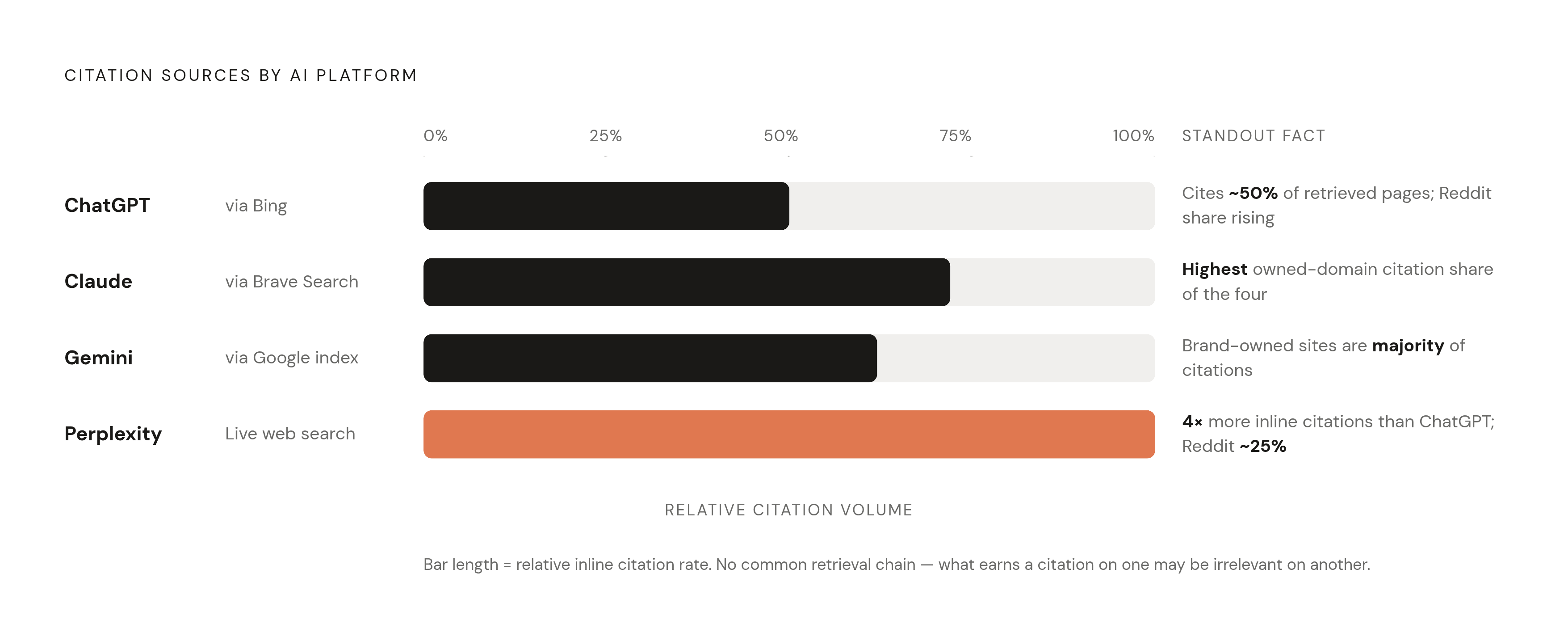
What makes this difficult to handle is that ChatGPT only gives credit for about 50% of the pages it uses in a live search, and most of those pages are from current results, not information it learned during training. A brand’s search rankings on Bing, and its overall online visibility, directly shape how often ChatGPT references it, but you’ll never see the connection unless you manually log every search result, one at a time, over weeks or months.
There's another factor to consider: OpenAI began showing ads in early 2026, but users with paid subscriptions aren't shown these ads. This creates two separate issues for ChatGPT. There are two distinct strategies at play: paid ads and organic mentions, and brands that fail to differentiate between the two will end up tracking the wrong metrics.
Despite the changes, the key indicators of authority that have always mattered, such as press coverage, Wikipedia entries, and a robust backlink profile, continue to be what ChatGPT values. The difference now is that ChatGPT doesn’t show you how it’s responding to your signals, so when results fall short, figuring out why is tougher here than on any of the other three platforms. The system offers no explanation for its choices.
Claude: a different retrieval chain that changes which brands get named in expert contexts
Claude doesn't use Bing. Claude uses Brave Search for retrieval, resulting in a vastly different set of pages compared to ChatGPT. One essential requirement that many brands overlook is that ClaudeBot must be permitted in robots.txt; without this allowance, the rest of the process is irrelevant. It's important to verify this before diving deeper into analysis, as failing to do so can undermine all subsequent findings.
Citations usually come from detailed, fact-rich pages that include genuine external links, and they often pull specific passages rather than just linking to the whole page. Research tracking brand mentions on major platforms indicates that Claude has the highest share of owned citations among the four platforms examined. That means Claude is the only platform where it pays off, unlike on the others, for brands to invest in creating and optimizing their own web pages, even though most aren’t doing it.
Many developers and technical experts now treat Claude as their go-to assistant. This makes Claude a crucial consideration for B2B tech companies and developer-tool makers, not just a peripheral issue: it's where their actual customers turn for advice on what to buy.
Pay attention to this closely. Anthropic regularly releases big updates to its model, and these updates can suddenly change which brands get prominent mentions, so it's essential to reevaluate Claude's visibility after each major release, rather than relying on previous results. The way sentiment is perceived can vary significantly between different platforms. For the same company and query, Claude and ChatGPT can give two very different takes on a brand's reputation, thanks to their distinct training data.
Gemini: brand-owned domains carry unusual weight, but the two Google surfaces disagree with each other
Gemini pulls its answers from Google’s search index and works best with content that uses correct schema markup, particularly when that content lives on the brand’s official website. Major studies of where Gemini gets its information found that most of its citations come from pages owned by the brand itself, a bigger percentage than for any other main search engine we looked at. Gemini stands out as the only major search tool where a company’s official website can dominate the citations, outpacing news articles, discussion boards, and even customer reviews.
This is the surprising part that often catches people off guard. Gemini chat and Google's AI Overviews are both developed by Google and use the same core index, yet they only have a limited number of shared citations for the same searches. Being cited in one doesn't guarantee citation in the other, meaning both require separate tracking, period.
On Gemini, Reddit is hardly noticed as a source for citations, particularly when compared to its presence on platforms like ChatGPT and Perplexity. A tactic that boosts visibility or engagement on other platforms, like Reddit-driven community discussions, has virtually no impact on Gemini. Instead, Gemini relies on recent information and strong connections to other Google services, making it the top choice for local businesses, online retailers, and any company linked to Google Maps or Shopping. Don’t mistake insights from one Google platform for truths that apply to the others.
Perplexity: real-time retrieval, heavy citation volume, and a community-source bias that changes what works
Perplexity operates on a fundamentally different basis. For every question, Perplexity conducts a real-time web search, with no limit on the recency of information, allowing even the most recent publications to be referenced in its responses. Perplexity includes about four times more inline citations per response than ChatGPT, according to available studies, making it the most traceable and measurable of the four platforms for observing how citations are used.
In early 2026, Reddit's dominance in this space, making up roughly 25% of all Perplexity citations, suggests a complete overhaul of strategies is necessary. A single helpful, on-topic reply in the right subreddit can boost a brand’s visibility in Perplexity more quickly than months of publishing content on its own website. Brands predominantly spend their money on the slower approach, which is the real error here, not simply a matter of preference.
On Perplexity, citations are earned by being in the right places on Reddit, having accurate and up-to-date directory and review listings, creating content rich in data and statistics, and consistently updating that content. Timeliness plays a key role in ranking here, rather than just serving as a way to break ties. Since Perplexity numbers and links citations directly in its answers, brands can see exactly when a referral occurs, from the moment a citation appears to the instant someone clicks it. Perplexity favors brands that are active across multiple platforms, Reddit threads, directories, and fresh data pages, over those relying on a single, deep page to attract visitors.
Why a single content strategy cannot work across all four platforms
The common ground between the references from ChatGPT and Perplexity is minimal. A brand that dominates citations on one platform may barely show up on another, even if its content is equally strong on both. This divergence goes beyond just the sources they cite. Research consistently shows that ChatGPT and Google’s AI tools often suggest entirely different brands for identical searches, despite both being the most widely used AI platforms globally.
The number of times a brand is cited varies greatly from one platform to another, with some platforms citing brands up to tens of times more frequently than others for similar searches. The amount of visibility varies greatly based on which platform the question is posed on.
Let’s break this down practically. Posts on Reddit and new data pages that do well on Perplexity are almost useless for Gemini, which relies on brand domains marked with schema instead. What gets Claude to cite your content is almost entirely different: it pulls from passages on highly trusted pages that Brave has indexed. Each platform has its own set of rules, and they don't apply to each other. Assuming you lump all AI search tools together and ignore the differences between them, just like lumping TikTok, LinkedIn, and Twitter into one "social media" category without checking where your audience actually hangs out, you’re setting yourself up for the same kind of failure. This situation means that although AI search platforms belong to the same broader category, each one has its own distinct set of content rules, making it impossible for a single piece of content to meet the requirements of all four platforms simultaneously.
What to actually monitor, and how the metrics differ by platform
Simply being visible doesn’t provide the full picture, and focusing solely on the number of mentions misses the mark. When an AI response warns against a brand or calls it a poor choice, that brand fares worse than one not mentioned at all, so you must track sentiment and recommendation quality just as closely as mention frequency.
Share of voice isn’t a single, universal figure. Different platforms pull from unique sources and cite them at varying rates, meaning a brand's share of voice in Claude's responses can differ significantly from its share in Perplexity's, even for the same company.
New versions of models can alter how they perform without any prior notice. Anthropic’s new Claude releases sometimes alter how citations work, while ChatGPT’s changes often stem from updates to its backend search system. This situation requires continuous monitoring against a consistent benchmark, so any changes become apparent as soon as they occur, rather than months later, when the consequences have escalated.
How you word a question is more important than many people think. If you phrase the same question differently on the same platform, the responses might suggest completely different brands. When you only test a single prompt for each topic, you miss out on most of the actual differences a brand faces.
Manual spot-checks catch almost nothing, they won’t show you the gradual shift in trends, the precise point when a rival gains ground in share of voice, or the specific week a model update changes which companies get mentioned in a category. Scheduled, repeatable queries run across all the relevant models are what actually catch it. Specialized tools like Lettertrace, an open-source solution designed for this exact purpose, automatically track the data, testing different prompts across every relevant model and compiling metrics on visibility, sentiment, and market share by both topic and platform over time.
How to allocate effort across the four platforms given your category and audience
Just because a platform has a larger audience doesn't mean it should get a bigger share of your budget; in fact, many companies misallocate their funds precisely here. A company focused on developer tools or a B2B SaaS brand needs to prioritize Claude and Perplexity over the sheer size of ChatGPT, since those platforms are where real buyers shape their views before engaging with sales.
For local businesses, commerce brands, and anyone deeply integrated with Google's ecosystem, it’s crucial to focus on both Gemini and AI Overviews, treating them as distinct platforms because their results often don’t align. When it comes to sealing the deal through community trust, Perplexity's strong reliance on Reddit transforms authentic community engagement into more of a citation tactic rather than a branding effort, yielding a clear, quantifiable benefit.
Brands aiming to earn trust with all types of buyers need to see ChatGPT’s massive reach as their starting point, not their end goal. You need to systematically check if Wikipedia, editorial press, and a strong web presence are actually effective, since ChatGPT won't tell you if they are working.
Companies monitoring every major AI platform today are laying down a reference point that will prove invaluable down the road. As soon as the next model update hits and rearranges the category, having six months' worth of data will provide clarity where there was previously uncertainty. Brands that delay will find themselves uncertain about what has shifted and the reasons behind it, long after the opportunity to take action has passed.
Begin with a straightforward approach: use the same prompts on all four platforms, monitor visibility and sentiment individually for each model, and avoid combining everything into a single metric. Each platform operates independently, so analyze its performance on its own terms.
Sources
- https://llmrefs.com/blog/chatgpt-vs-claude-vs-perplexity
- https://metricusapp.com/ai-platform-comparison-brands/
- https://joinhexagon.com/blogs/ai-search-engines-ranked-2025-chatgpt-perplexity-claude-gemini-compared
- https://knwn.app/blog/chatgpt-claude-gemini-perplexity-brand-coverage
- https://vydera.com/en/lab/gemini-vs-chatgpt-vs-perplexity-vs-claude-vs-copilot-visibility