

How Open-Source AEO Tools Handle Bring-Your-Own-Key Setups
Open-source AEO tools differ in how they handle bring-your-own-key setups, and those differences affect more than API bills. A key under your account gives you control over the model-provider relationship. It does not automatically give you control over prompts, credentials, or stored results. The strongest ownership argument comes from pairing BYOK with an auditable application and a storage layer you own.
Why BYOK in AEO tools is a data ownership question first, and a cost question second
Direct API costs for moderate AEO monitoring can be a fraction of what closed platforms charge. But the bill is only the surface benefit. Control over the data flowing through the key extends from the prompt assembled before a request to the response saved afterward. That chain of custody determines who can inspect your monitoring activity and whether you can take its history elsewhere.
BYOK has two distinct meanings in this context. The first is that you supply the API key, so calls run under your account and your provider terms. The second, stronger version is that you also supply and control the storage where results land. The distinction is easy to miss. Paying the provider directly does not make you the owner of a database that the application vendor holds.
A closed, hosted tool asks you to trust scores computed from prompts its servers assemble. An open-source tool lets you inspect how requests and metrics are built. That inspection can expose what happens between a query and its recorded result, but the deployment still has to match the ownership claim.
What BYOK actually protects — and what it does not
BYOK changes whose contract governs an API call. Calls to OpenAI, Anthropic, and paid Google tiers use terms that keep your data out of model training by default, unlike products made for consumers. This is a substantial protection. It also ties GDPR data processing agreements and SOC 2 audit trails to a provider you chose, bypassing an intermediary you cannot inspect.
Those protections do not mean data stays on your machine. The application can still read, log, and retain prompts before forwarding them, and a server-side request-builder can still access your credentials. A browser-only application keeps that data out of an application server’s reach. Self-hosting puts the server under your control if it runs on infrastructure you control, but a convenient third-party deployment does not give you that control.
Keeping data off cloud model providers takes a local model. Gego’s Ollama integration illustrates that boundary by allowing a fully local tracking loop, though that does not replace monitoring across cloud-based answer engines. Credentials need protection of their own, too. The aeo-platform CLI reads keys from environment variables at runtime and never persists them, avoiding the stored-secret exposure created by a database or configuration file.
How the open-source AEO tools in active development handle these tradeoffs differently
The open-source AEO field is early, but its tools already make distinct architectural choices. GEO/AEO Tracker is an MIT-licensed, local-first dashboard that stores results in the browser’s IndexedDB, with optional persistence in a Supabase project the user owns. Its browser-first design removes an application server from the request path. However, its use of Bright Data’s LLM Scrapers introduces a separate intermediary for querying live AI interfaces. Its one-click Vercel deployment also differs from hosting on your own infrastructure.
The MIT-licensed aeo-platform takes a narrower, simpler route. It is CLI-only, has zero runtime dependencies, and queries ChatGPT, Claude, Gemini, and Perplexity through official APIs. There is no scraping intermediary in that path. It saves local HTML/Markdown reports instead of keeping a persistent database, so users must keep their own dated files to track trends. Its published scoring grids include runs where the brand is not cited, making the output open to scrutiny.
Lettertrace makes the strongest end-to-end ownership argument by separating the application from storage. Its application is MIT-licensed, auditable, bring-your-own-key, and self-hostable, while results sit in a Supabase project the user provisions and owns. Storage is not tied to the tool vendor. With no usage markup and no vendor lock-in, that design addresses both the provider relationship and custody of the monitoring history.
Elmo offers a broader self-hosted platform using Docker and PostgreSQL. It covers engines including ChatGPT, Google AI Mode, Google AI Overviews, Gemini, Copilot, Perplexity, Claude, Grok, and OpenRouter models, with REST API, SDK, MCP, and agent integrations. The database location remains the ownership hinge. A PostgreSQL instance you provision differs from a managed service with its own access terms. Elmo Cloud is a legitimate convenience option, but it reintroduces a hosted data layer in exchange for managed infrastructure.
Canonry, also MIT-licensed, puts agent workflows first. Its Aero agent exposes a 48-tool MCP adapter, and the tool combines engine tracking with server-log ingestion and integrations including Google Search Console and GA4. OneGlanse makes a different input-side choice. It captures answers through authenticated consumer accounts rather than model APIs, while keeping results in PostgreSQL and ClickHouse on the user’s infrastructure. That gives users strong ownership of their storage, but they lack the API-term protections that come with direct model calls.
Ansvisor puts transparency into the scoring layer by publishing its formula in the repository. Gego instead emphasizes scheduled execution, using Docker and an etcd-backed scheduler, with Ollama supporting its local-model option. Their distinctions extend beyond features and coverage. Ansvisor is MIT-licensed, while Gego uses GPL-3.0, whose copyleft conditions need consideration when teams intend to modify the code. Neither a feature count nor the BYOK label captures these differences.
Where the data path actually breaks down: the scraping layer and the normalization problem
Scraping exists because an API is not always available, and API answers can differ materially from consumer-interface answers. ChatGPT’s web interface, Google AI Mode, Copilot, and Grok present script-rendered, bot-blocked surfaces that vary as sources of answers. Their response structures differ as well. Perplexity uses markdown with inline sources, Gemini supplies citations as a separate structured array, and Grok exposes response_raw as well as answer_text_markdown.
Bright Data’s LLM Scrapers normalize these differences across six formats through a single API pattern. That solves a real engineering problem for the tracker. It also puts an intermediary into the path whose terms govern the scrape, regardless of who owns the eventual results. Where does the request go before it reaches the model, and what are that intermediary’s terms?
That route affects measurement as well as privacy. The same prompt can produce different answers and citations depending on the country from which the request appears to originate, making proxy geography a measurement variable. Normalization can change the input conditions, too. A gateway that accepts search-grounding parameters but quietly drops them returns an ungrounded answer. Direct-API tools such as aeo-platform, Lettertrace, and Elmo for supported engines avoid this scraping layer, but cannot reach platforms without public APIs.
What monitoring data is worth protecting: prompt strategy as competitive intelligence
A monitoring library records what a business wants to learn about its market. It exposes target segments, tracked competitors, and tested objections. That is commercially sensitive material. A hosted tool that holds the library therefore has a map of how the brand positions itself against competitors, even before any model answers arrive.
A comprehensive library covers five prompt types, including informational, comparative, instructional, brand-specific, and transactional prompts. Comparative prompts are only part of the picture. Unbranded discovery queries show whether models bring up a brand when the prompt does not name it, and teams often leave them out. Building 6–8 variations per core query across formality, specificity, and question frameworks turns that library from a loose collection of searches into a research artifact.
Persona fan-out adds another layer of intelligence. An agency perspective can produce different recommendations from a startup founder’s or an in-house marketer’s perspective. Those differences map how visible the brand is to different buyer segments. Scheduled monitoring then turns that map into a time-series dataset that shows what changes around content campaigns or competitor moves. Owning the storage protects this mix of questions, buyer perspectives, and past answers, giving it value for strategy as well as privacy.
The metrics that make AI brand monitoring worth doing systematically
AI Share of Voice, citation rate, and sentiment are the main measures to track. They need a stable prompt set and a consistent method over time. A manual check provides only a data point. Scheduled monitoring supplies the history needed to distinguish an isolated answer from a trend, while control of the setup makes the method reproducible.
AI Share of Voice divides the number of times a brand is mentioned by the total number of brand mentions across the prompt set. When that set changes, so does the basis for comparing results. Scoring systems also differ in how they score appearances, so a dashboard score should not be treated as a measure that works the same everywhere. Ansvisor gives mention count the dominant weight, caps it to prevent spammy responses from skewing results, and gives first-mention position and citation presence smaller, equal weights. Its published formula makes those choices inspectable.
A weighted approach can also account for mention type and recommendation strength. A recommendation has more commercial value than a passing reference. Sentiment remains a separate signal because frequent negative descriptions are not a visibility success. Models describe brands rather than simply listing them, shaping a buyer’s impression before a site visit. Lettertrace’s tracking of visibility, prominence, sentiment, and share of voice per topic and per model over time illustrates how systematic measurement can preserve those distinctions.
Competitor context makes those measures more useful. Each run should record which competitors appear, their positions, and their framing in the same answers. Citation Opportunities finds URLs where competitors get citations but the tracked brand does not, showing a gap in content as well as a score. Model coverage is equally important to interpretation. A brand can appear first in one model, fifth in another, and nowhere in a third, so a single-engine view cannot represent discovery across the broader user population.
What to verify before building on or adopting an open-source BYOK AEO tool
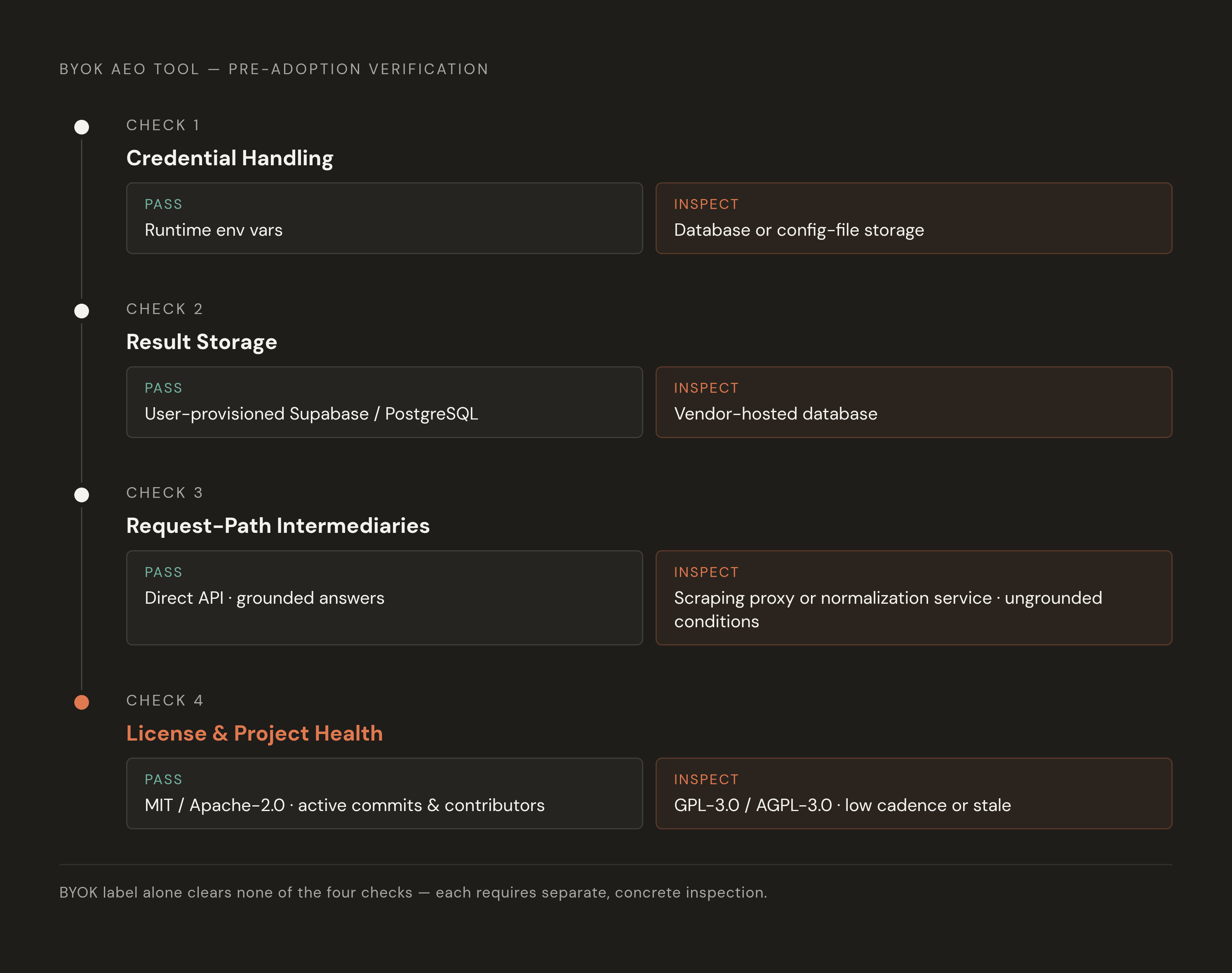
Test four parts of the ownership claim before adopting or building on a tool. Start with how it handles API credentials. Runtime environment variables avoid persisting keys, while database or configuration-file storage creates a credential that can be extracted even if the application code is clean. The BYOK label alone says nothing about that distinction.
The second check is where results land and who controls that storage. A Supabase project or PostgreSQL instance you provision keeps the historical dataset under your control. A vendor-hosted database puts the historical dataset back under the vendor’s control. That is also a continuity risk, because a discontinued service can take access to trend data with it. Lettertrace’s separation of its open-source application from user-owned Supabase storage is one concrete design that addresses this check.
The third check follows every intermediary in the request path. Direct API access differs from a scraping proxy or normalization service, whose terms and handling need separate attention. Measurement conditions belong in this inspection as well. Grounded versus ungrounded answers and where a request comes from can change what a result means, even when the way data is kept private is acceptable.
The fourth check concerns the license and intended use. MIT and Apache-2.0 place minimal conditions on modification and redistribution, while GPL-3.0 and AGPL-3.0 add copyleft conditions relevant to forks and commercial development. Project health deserves scrutiny beyond the license. Recent commit cadence, active contributors rather than stars, and updates after provider-format changes help show whether the tool can keep measuring the live answer environment.
The tools teams will need in 18 months are probably not all listed here. Owning the data, prompt library, and storage from the start gives a team room to migrate, fork, or extend without starting over.
Sources
- GitHub - webappski/aeo-platform: Open-source AEO/GEO CLI — measure your brand across ChatGPT, Claude, Gemini & Perplexity, audit AI-bot crawlability + authority signals, then export a brand-context you paste into any AI for a personalized 30-mission AEO plan. Zero deps, MIT, local-first. Built by Webappski. · GitHub
- GitHub - danishashko/geo-aeo-tracker: Open-source AI visibility tracker and AEO checker. Track how ChatGPT, Perplexity, Gemini and Google AI Mode mention and cite your brand. MCP server + CLI. Self-hosted, MIT. · GitHub
- GitHub - TerritoryLead/geo-aeo-tracker: Open-source, local-first AI visibility intelligence dashboard. Track your brand across 6 AI models. · GitHub
- GitHub - elmohq/elmo: Open-source Answer Engine Optimization (AEO) and Generative Engine Optimization (GEO) platform. Track how ChatGPT, Claude, Perplexity, Gemini, Copilot, Grok, and Google AI Overviews mention and cite your brand in AI search. MIT-licensed, self-hostable, every metric auditable in code. · GitHub