

How to Do Answer Engine Optimization Step by Step

Answer Engine Optimization is the work of getting your brand included and cited in AI answers. It follows a clear sequence, from auditing your visibility to building content and authority. But publishing is not the finish line. Continuous measurement is what tells you which work paid off, what needs fixing, and where the next effort should go.
Why AI answer engines have changed what it means to be visible
An answer engine reads dozens of sources, produces one response, and cites only a handful. Your brand is competing for space inside that response. If it is missing, buyers may never consider it, even when your site has useful information.
The route into that answer varies by platform. Google AI Overviews and AI Mode retrieve information from Google’s Search index, while Perplexity crawls the web in real time and provides inline citations. ChatGPT combines training data with search access through OAI-SearchBot. Those differences make visibility a channel-by-channel problem. Because appearances and referrals can be measured, the work deserves a systematic approach.
What the full AEO sequence looks like before you start any step
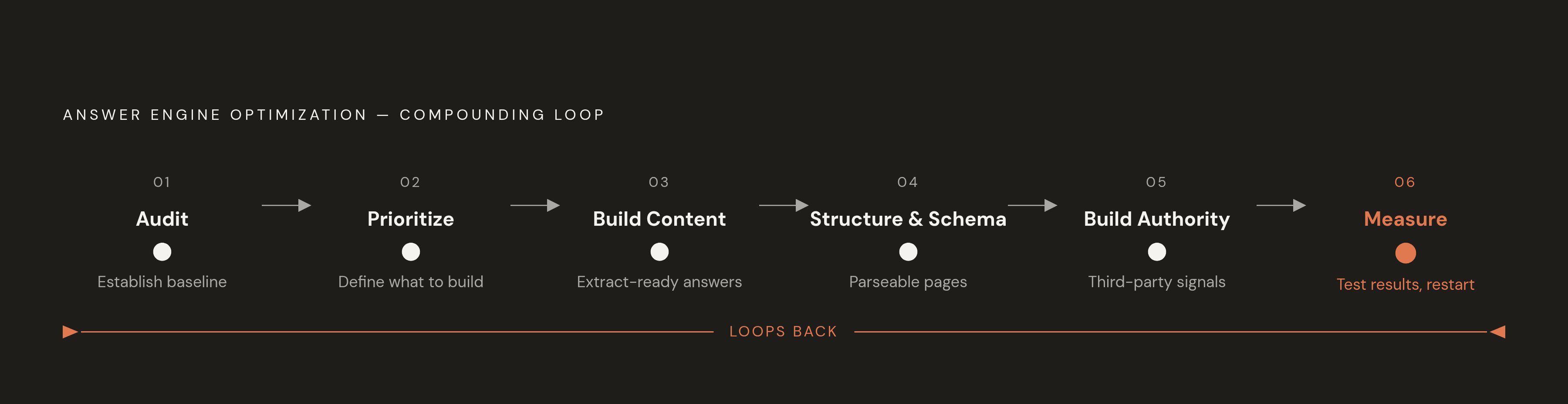
The six phases are audit, prioritize, build content, structure and schema, build authority, and measure. Each removes a different reason an engine might skip you. A page must be retrievable before it can be cited, clear enough to extract before it can support an answer, and credible enough to survive source selection. Much of this overlaps with existing SEO work.
The order gives that work a purpose. An audit establishes the baseline, prioritization defines what to build, and measurement tests the result. Measurement comes last in this sequence because it needs something to compare. The steps below follow that order, then show how tracking turns the sequence into a loop.
Running your baseline audit across the engines that matter
Start with questions your buyers actually ask. Run a representative set through ChatGPT, Perplexity, Gemini, and Google AI Overviews. For each answer, record whether your brand appears, whether its description is accurate, and which competitor or third-party source appears instead. Examine the winning passage’s structure, too. A missing mention and a misleading description are different problems, and your scorecard should keep them separate.
Check retrieval before assuming that every missing mention is a problem with the writing. Priority pages should be indexable, server-rendered, and readable without scripts that block crawler access. Google’s AI search features use Googlebot and require pages to be indexed and eligible for snippets. ChatGPT search uses OAI-SearchBot, while GPTBot is for training, so blocking GPTBot does not remove a site from search. Perplexity uses PerplexityBot, and Microsoft Copilot uses Bingbot.
Google’s Search Console Help states that its Search generative AI control rolled out to all websites worldwide as of August 31, 2026. Check that it is set to “Include.” An “Exclude” setting removes links and content from AI Overviews and AI Mode within days. With these access checks complete, your scorecard can distinguish questions you win, close gaps, and outright absences. Those distinctions become the input to prioritization.
Deciding which questions to target first
Rank questions by buyer intent and winnability together. Commercial investigation and transactional questions are closer to a purchase than broad questions about what things mean. A citation on a question your buyers never ask has little business value. Use People Also Ask patterns, forum discussions, and customer support logs to find the language buyers use, then classify questions by intent.
Next, use the audit to see how strong the competition is. Thin answers leave more room to win than sources with authority that cover the topic in depth and are up to date. Work on close gaps before wide ones because a small change to the content may be enough to change the result. A wide gap may take a campaign that runs for longer.
Keep the target set focused without narrowing it to one kind of question. Include brand-specific, category, comparison, and problem questions so it covers more than early research. The aim is to define a manageable set of pages whose effect the first measurement cycle can reveal.
Writing answer-first content that AI engines can extract and cite
Open each main section with a short, direct answer to the question in its heading. Put the primary concept in the first sentence or two. Definitions should follow the plain form “[Term] is [clear definition].” That gives the model a passage it can extract without needing the rest of the page to explain it.
Write headings in the buyer’s language. Support claims with verifiable evidence and named sources, and keep related facts together under logical headings. Accuracy still comes first. But an accurate answer buried inside a long paragraph is harder to extract than a self-contained explanation with clear support.
Google’s May 2026 AI guidance says that optimizing for AI search “is optimizing for the search experience, and thus still SEO.” That makes a useful, well-structured SEO page a renovation project. Freshness also influences source selection, so the answer must remain current as engines retrieve it again. A model reads dozens of sources and synthesizes one answer. Make your page’s contribution easy to extract and attribute.
Structuring pages and adding schema so models parse them without misreading
Give each page a heading hierarchy that makes sense and question-and-answer blocks that stand on their own. Where the content calls for it, comparison tables and numbered processes make relationships explicit. Fast load times and server-rendered HTML support access to that content. Even well-written content needs to be on a page the crawler can read.
Schema can clarify structure, but its value is not uniform. FAQPage schema marks up question-and-answer pairs, which makes it relevant to FAQ content. Google’s documentation, however, says that special schema, content “chunking,” and llms.txt files are not needed for its AI search features. Those features use the retrieval and quality systems of core Search. Do not put Google-specific schema work ahead of content and authority on the assumption that AI requires a separate markup system.
For non-Google engines, publishing or updating llms.txt is a cheap way to test whether naming preferred sources helps, though a gain in visibility is not guaranteed. Monitor whether it changes anything. Also set up referral tracking at this stage of the technical work, using UTM parameters and custom channel groups in GA4. These hooks will let you link AI visibility to visits when you measure results later, so you can track more than citation counts.
Earning the third-party authority signals that make a model willing to cite you
Your own pages cannot do all the work. Brand-owned sites account for only a small minority of cited sources, while media, user-generated content, and affiliate publications make up the remainder. That makes earned placement structurally important.
Use the sources appearing in your audit to direct authority work. Earn placements on relevant sites through PR outreach, work shared by experts, and efforts to get reviews, while spending less time on sites the engines rarely cite. Real discussions on Reddit, an earned presence on Wikipedia, and work shared in trusted publications in the category can all give engines third-party signals. Genuine mentions on frequently cited, authoritative domains are more useful than a broad scatter of thin placements.
The underlying signals are experience, expertise, authoritativeness, and trustworthiness. They help explain why a model selects one candidate source over another. But credibility does not register equally across every engine. If an authority campaign focuses on the sources one engine prefers, your brand may still be missing from the others.
Why cross-engine divergence makes single-platform monitoring a losing strategy
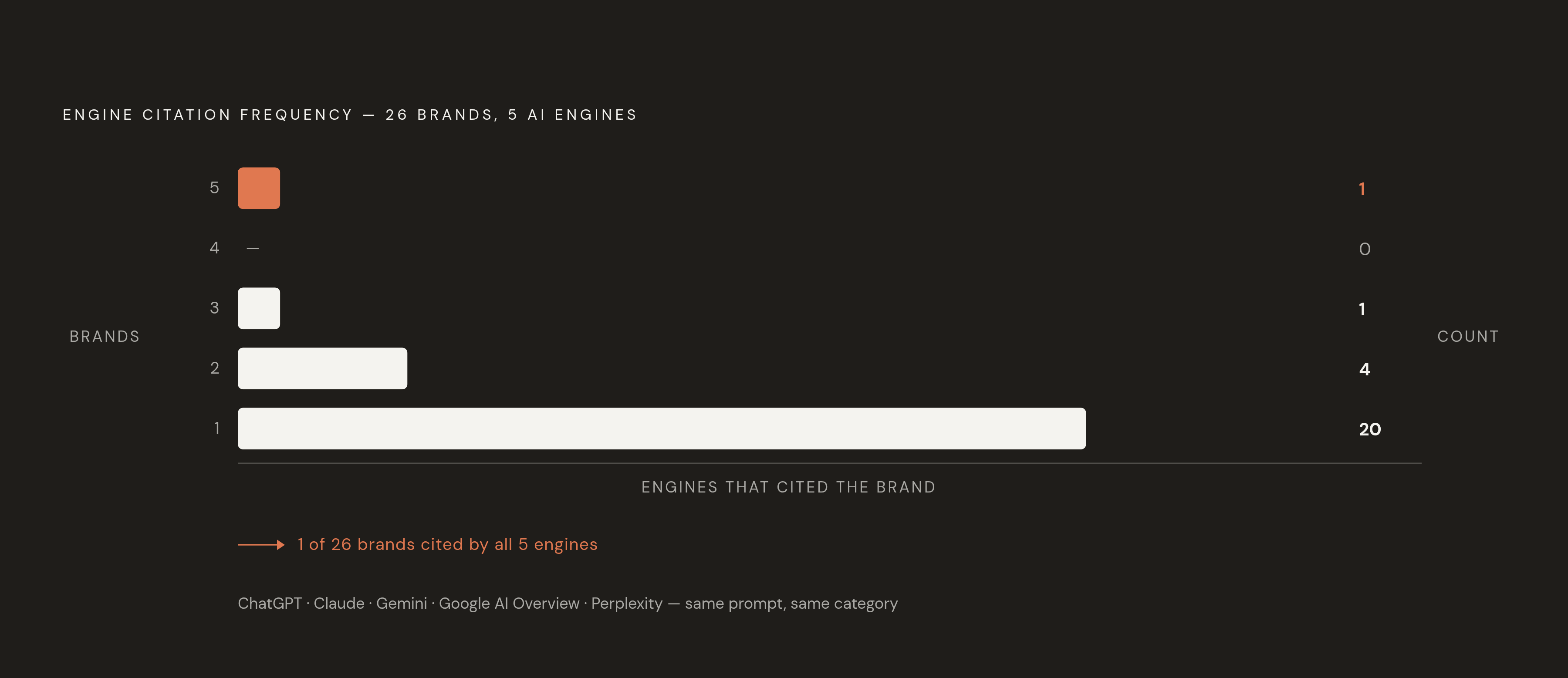
In one test, five AI engines were given the same prompt and cited 26 brands. Only one appeared unanimously, while the large majority appeared in just one engine. That is a substantial blind spot for single-platform tracking. A strong result in ChatGPT cannot stand in for performance across the channel.
Buyer intent adds another source of divergence. Research into buyer-intent responses across ChatGPT, Claude, Gemini, Google AI Overview, and Perplexity found very low average domain overlap as questions shifted from discovery to shortlist. A brand can show up in early research and drop out when the buyer compares the final choices. Tracking awareness questions alone can therefore reward the wrong success.
Benchmark across awareness, consideration, and decision, as well as across engines. Perplexity deserves attention because its inline citations can produce trackable referral traffic when users click through. But referral counts remain a floor because zero-click answers and stripped referrer headers leave some exposure uncounted. Once engines, prompts, and intent stages are combined, occasional manual checks cannot provide dependable coverage. The build work now needs a repeatable measurement system.
Measuring share of voice in AI answers as a continuous, structured discipline
For the tracked set, calculate share of voice as brand mentions divided by total AI answers. The prompt set defines what the number means. Keep it tied to the category and buyer journey so an increase reflects progress on questions your buyers ask.
Start with 50–100 prompts that fit the category and cover brand, category, comparison, and problem questions. Segment them by awareness, consideration, and decision, then run them across ChatGPT, Perplexity, Gemini, Claude, and Google AI Overviews. Score each response for brand presence, position, and sentiment. A mention framed as a cautionary example or containing a material inaccuracy reaches the buyer at exactly the point when the description can shape consideration.
Models can return different results on successive runs of the same prompt, so the operational minimum is five runs per prompt, ideally spread over multiple days. More rigorous benchmarks use substantially more. Consistent collection makes changes interpretable instead of leaving you to guess whether a new answer reflects progress or ordinary variation.
Lettertrace automates that repeated work by crafting prompt variations, querying ChatGPT, Claude, Gemini, Google AI Overviews, and Perplexity Sonar, and aggregating results over time. It tracks visibility, prominence, sentiment, and share of voice by topic and model. The monitoring data stays in a user-owned Supabase instance. Lettertrace is permissively licensed, self-hostable, and bring-your-own-key, with no vendor markup or lock-in. You still need to decide which questions deserve attention.
Link those results to what they bring the business when referral data lets you do so. ChatGPT appends utm_source=chatgpt.com to referral links, Perplexity referrals appear as perplexity.ai in GA4, and Google Search Console’s Generative AI performance report surfaces AI Overviews data. Use the channel groups set up earlier to separate AI referrals and see how much they add to pipeline and revenue. Citation tracking alone cannot tell you whether visibility is producing useful demand.
Using measurement output to close gaps, update content, and restart the loop
Use each measurement cycle to revise the next content queue. Changes in share of voice show where competitors gained ground, where your work improved visibility, and where nothing moved. Prioritize close gaps that the new data exposes.
Handle negative or inaccurate framing as its own task to fix. More mentions will not fix a description that misrepresents the product. Change the underlying content or positioning that needs correction, then track whether the framing improves. For pages losing citations, use the trend to prioritize freshness work. Leading AEO brands update content quarterly, but tracking results helps show which pages need work first and which updates can wait.
Feed the same evidence into authority work by targeting third-party sources that repeatedly appear in category answers. Each cycle can then improve both the pages you control and the outside signals that support them. That is how the effort compounds. The next cycle starts with a better baseline and a sharper view of where work pays off.
What does your first measurement cycle look like?