

Why Enterprise AEO Is Moving From Dashboards to Agents
How AI brand visibility works, and where most companies fall short
Most tools mix a couple of things that shouldn't be combined. That mix-up is why lots of AEO dashboards seem bad right when you want one.
An entity-based mention measures recall: is your brand front of mind when a category query comes up? Citation-based presence is about impact: does the content you publish become a real basis for the reply? You might lead in one area but trail badly in the other, yet standard tracking tools fail to show which situation your brand faces right now.
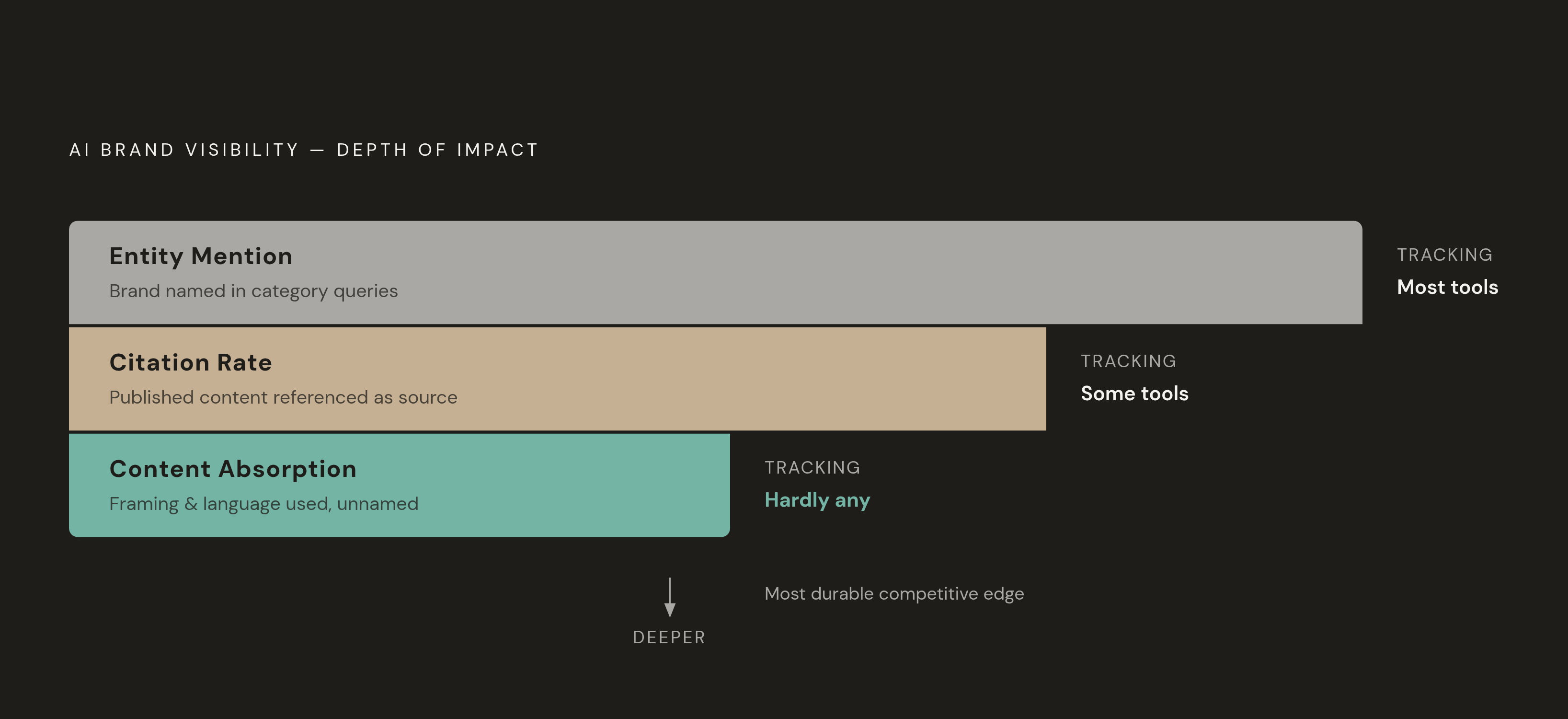
A layer most companies never track: content absorption. Without a citation anywhere, that model's phrasing can include the definitions you use, plus framing and positioning. An AI can frame your category using the exact language your article had, all while never naming you. This is absorption. It could be the deepest kind of impact, since it shapes how someone views the issue before your brand ever comes up.
Most groups underrate how much tone matters in this context. When an AI paints a brand in a bad light, that portrayal spreads through countless distinct exchanges, leaving no post to reply to and no feedback to mark. It sits, then replicates, hidden from any tracking tool made for the previous decade's web.
Attribution only makes things harder. AI Overviews plus AI Mode provide zero tracking details. Not until June 2025 did ChatGPT begin tagging URLs inside its "More" area using the utm parameter. A report from Digital Bloom said the bulk of visits from AI-referred sources come with no source data, though that number isn't confirmed widely. See it as directional.
A minority of marketers measure AI citations, even as many say AI search optimization is central to their 2026 plans. Most marketers recognize the importance but still don't track it, and this is precisely the gap agent-based platforms seek to close.
You can use a dashboard tracking visits and mentions to see recent activity. It won’t reveal what the system really output, in what style, or in what setting, and it won’t indicate if your content is still quietly shaping a model's vocabulary. That needs another kind of metric.
AI Share of Voice as the enterprise metric that unifies brand, content, and competitive data
AI SOV, or AI Share of Voice, tracks how often your company gets a mention in AI-generated category results. Easy enough to nail down. Tough to shift without a tool tracking the number each day rather than every three months.
Recent benchmarks suggest brands appear in AI results roughly one-sixth of the time. Benchmark data indicates 10% to 15% is a solid AI SOV for established brands, while enterprise leaders target 25% or higher. Those bands are tight enough that a few percentage points separate "present" from "dominant."
This isn’t vanity, and seeing it as one costs groups funding for the coming year. AI-referred traffic converts at a significantly higher rate than traditional organic traffic. SOV sits upstream in revenue, not downstream in monthly updates that get skimmed then forgotten.
Track recall and citation rate apart, since each covers its own ground. Recall tells you if the AI recognizes your brand exists within the category. What citation rate tells you is if your content gained the credibility to get referenced. Measuring absorption is tougher than tracking those two, yet it offers the longest-lasting advantage: a rival can outperform you on citations even though your framing keeps shaping the words the entire category speaks.
Most tools stop before the third. Hardly any track absorption so far. Whoever's quietly shaping the way models frame a whole field has an edge citation numbers can't catch.
Monitoring your brand's SOV solo won't cut it at the enterprise level. Using the same prompt set against 3 to 5 rivals points out where real gaps sit, plus which models systematically pick certain companies. One single-brand dashboard won't deliver that, full stop.
It all breaks when weak or limited prompts go into it, and many monitoring setups quietly fail there.
How prompt choice determines the value of monitoring data
AI answers are not deterministic. Repeating the exact same prompt may yield separate brand mentions each time. New releases can alter synthesis patterns without notice anywhere; even one phrasing shift inside the prompt may shift every citation. A tracking program built on a handful of static queries is measuring noise dressed up as signal, and teams that skip this step are the ones whose dashboards mysteriously stop matching reality by month three.
A solid real query set has to include all four prompt kinds, not just one or two picks. Brand-direct queries ask "what does [brand] do." Category queries ask "best [category] tools 2026." Comparison queries ask "[brand] vs [competitor]." Problem-aware queries ask "how to solve [problem]." Skipping any one of these loses visibility into a whole slice of how customers actually use these tools.
Most groups overlook qualifiers because the cues stay hidden, yet these signals act as the real lever driving brand displacement. If a model has learned to associate your brand with enterprise-grade security, but the user's prompt asks for something "low-cost" or "easy to set up," your brand's weighting in that answer drops fast. Price-based qualifiers push the answer toward community-led, open-source options. Usage-related qualifiers pull the model toward how-to documentation. Opinion qualifiers pull from third-party news coverage. Every qualifier reroutes AI toward its own material, yet most companies can't tell which qualifiers are hurting them right now.
The narrowing from Over-indexing on a single prompt cluster goes unnoticed until something real is lost. A brand that becomes the model's go-to answer for "cheap alternatives" can end up structurally locked out of "premium solution" queries, no matter how much the actual product has changed since that reputation formed.
Recent tracking indicates AI tools often reinterpret user prompts rather than searching verbatim. They branch into changed smaller questions out of sight; people say ChatGPT doesn't look the same way again. Targeting one keyword was the heart of SEO, yet none of that applies here, and holding on means working for a search tool that's gone.
Differences between AI systems make the issue worse. With the same exact prompts, a gap shows up: one AI platform mentions a brand tenfold more than another, sometimes fiftyfold. Monitor one model, and the "whole picture" being reported back is actually a fraction of the real competitive landscape.
People can't do any of it manually. Prompt changes with multi-model coverage plus regular checks all require automation, since someone looking manually fails to produce enough query runs to find a pattern that really says something. That gap in execution is the main reason enterprise AEO teams are moving beyond fixed dashboards.
Big-company AEO tools shifted from charts to bot-led action during 2026.
The inflection came in Spring 2026. Over a short span, major marketing platforms turned the slide-deck notion of AEO into live tools: the Spring 2026 Spotlight saw HubSpot AEO, April 2026 brought Conductor's AgentStack, plus Siteimprove got AEO insights folded inside it. That pace is what tells the story: "worth exploring" became table stakes for the whole category in months, not years.
Since May 2026, enterprise customers can use Webflow AEO, which links AEO Analytics to the agent layer inside one loop. Analytics shows how often sources cite, which queries cause references, and ties AI-driven reach to site activity. Next, the agent layer highlights prioritized fixes like dead URLs, stale metadata, absent alt or schema tags, and content gaps, then ships edits live in bulk following a publish-only-after-approval gate. Funding tops $330 million; agent usage will need AI credits starting on 2026, June 29. Webflow's team polled 100 marketing leaders alongside 300 practitioners, and marketing leaders at 93% called AEO vital for brand wins within the coming two-year span, yet a persistent gap still stands between spotting problems and getting them live. It says it fixes that gap. Rebecca Strehlow, Editorial Lead at Crunchbase, said the agents let her "instantly do work that wasn't feasible before, like optimizing metadata across hundreds of pages at scale."
LLM Optimizer, shown during Adobe Summit 2026, combines AI-visitor checks, missing-topic checks, and instant site updates. Adobe says over 600 enterprise customers are already using it.
An infrastructure layer for builders, Conductor AgentStack came out in April 2026. For ChatGPT, alongside Claude and Copilot, it provides native LLM apps, with an MCP server and APIs for groups creating their own agents. Conductor positions AEO outright as the backbone, not a dashboard add-on: automation built to drop reporting hours and move faster the making of AI-ready search content.
AEO launched at Spotlight in Spring 2026 with rival tracking, reference reviews, ranked advice, and question ideas linked to a business's own buyer info. The company noted a 27% annual drop in search visits among users, paired with rapid growth in AI-driven visits, and created the tool specifically to address this change.
Underneath the marketing, all four tools follow the same three-step setup: measuring, then checking and suggesting, then carrying it out. The 2026 shift comes down to that loop. It moves visibility data straight to live updates, no jumping between platforms required.
CMOs adopting new tools flag the same issue: agentic execution calls for tighter guardrails plus oversight, above all in customer-facing areas. The baseline condition enterprise buyers expect is a review-before-publish step before they'll let any agent touch live content. That's the floor enterprise buyers require before letting an agent touch live content.
Enterprise AEO platform options: specialized monitoring versus full-stack agent infrastructure
Companies picking a system today hit a genuine split: AEO monitoring software designed for focus on one end, wider agent systems made for groups that prefer to build their own processes on the other. The costs, data models, plus assumptions behind them are so unlike that this call shapes the way a group works long term, not briefly.
The infrastructure side is where Conductor AgentStack sits. Conductor's wider tools are Creator for AI content work, plus Intelligence to track visibility, and Monitoring for checks, while AgentStack layered above serves as its developer-first part. With APIs, Native LLM apps, and an MCP server, groups having developers can craft their own AEO agents using Conductor's current data layer rather than adopting a set workflow.
AthenaHQ goes with a package-pricing plan instead. On June 24, 2026, AthenaHQ offers tiered pricing for its plans. AthenaHQ supports multiple AI platforms. It suits groups looking for coverage across multiple models on a predictable monthly price, without building their own infrastructure.
Lettertrace does the reverse: MIT code, free to host anywhere. It serves practitioners in AEO work and GEO needing systematic visibility tracking on Claude, ChatGPT, Gemini, Google's AI Overviews, plus Perplexity, free from vendor lock-in and API markup. It uses customer API keys, so no extra fees are added, and stored monitoring records stay in a customer-controlled Supabase setup, not a vendor system. That setup is the whole point for groups who need their loop automated yet refuse giving up visibility data toward any third-party platform.
No single option feels right to all teams, and many buyers won’t value them the same way. A packaged subscription tool like AthenaHQ lets a group launch quickly with no overhead. For most groups just getting going, it beats creating an infrastructure setup they can skip. Conductor AgentStack pays off only when a company already has developers who can make something useful from solid information. Lacking that means overhead, zero payoff. Lettertrace works for groups where control over their information is a must, period, and easier options won’t alter that call.
No team can carry the cost of any dashboard that merely reports on past events, whatever direction they choose.