

Do Brand Mentions in AI Answers Help Your SEO

Brand mentions in AI answers can reflect stronger SEO foundations, but they are not a proven shortcut to higher rankings. Both channels respond to the same signal: whether the wider web treats a brand as one it can trust, one that fits the question, and one whose role is clear. The useful work is building that reputation, then measuring how search engines and AI systems respond.
Why AI answers and search rankings respond to the same underlying signal
An AI system answering a customer’s question needs more than a recognizable brand name. It needs context that makes the brand a credible choice for that question. In this sense, language models act as trust engines, drawing on a brand’s wider digital footprint. When a name keeps appearing alongside a clear category, they have something they can use. Recognition alone is not enough to establish relevance.
Google’s organic ranking systems also use natural language processing to understand entities and the context around them. They can interpret how a brand is described. That ability to interpret brand descriptions helps explain why third-party mentions that describe the brand, a name used the same way, and a place on trusted platforms can help both search rankings and AI answers. The common foundation is entity trust.
How AI systems actually process a brand mention
When an AI system processes a brand mention, the useful operation is entity recognition. It connects the name to a real-world entity and interprets the topics attached to it. A third-party description that places a brand next to “email platform” or “iPad case” supplies that connection. The surrounding words do real work here. They help distinguish a recognizable name from a relevant answer to a customer’s question.
Systems using Retrieval-Augmented Generation, or RAG, fetch information from external sources and summarize it. A brand that appears across those sources has more opportunities to enter the resulting answer, even when the references contain no hyperlink. Unlinked text is still readable evidence for both search engines and language models. A relevant forum reference can therefore be more useful to an AI system than a sponsored guest-post link. The distinction is the context and apparent human consensus.
Exact-match names are not the whole signal either. Modern systems can also process references to a brand through its product, founder, or a description such as “the agency behind X.” These implicit mentions extend the evidence beyond a simple name count. That makes entity clarity especially useful. Different descriptions need to make it clear that they refer to the same brand, what category it belongs to, and what it does.
What the correlation data actually shows — and where it stops
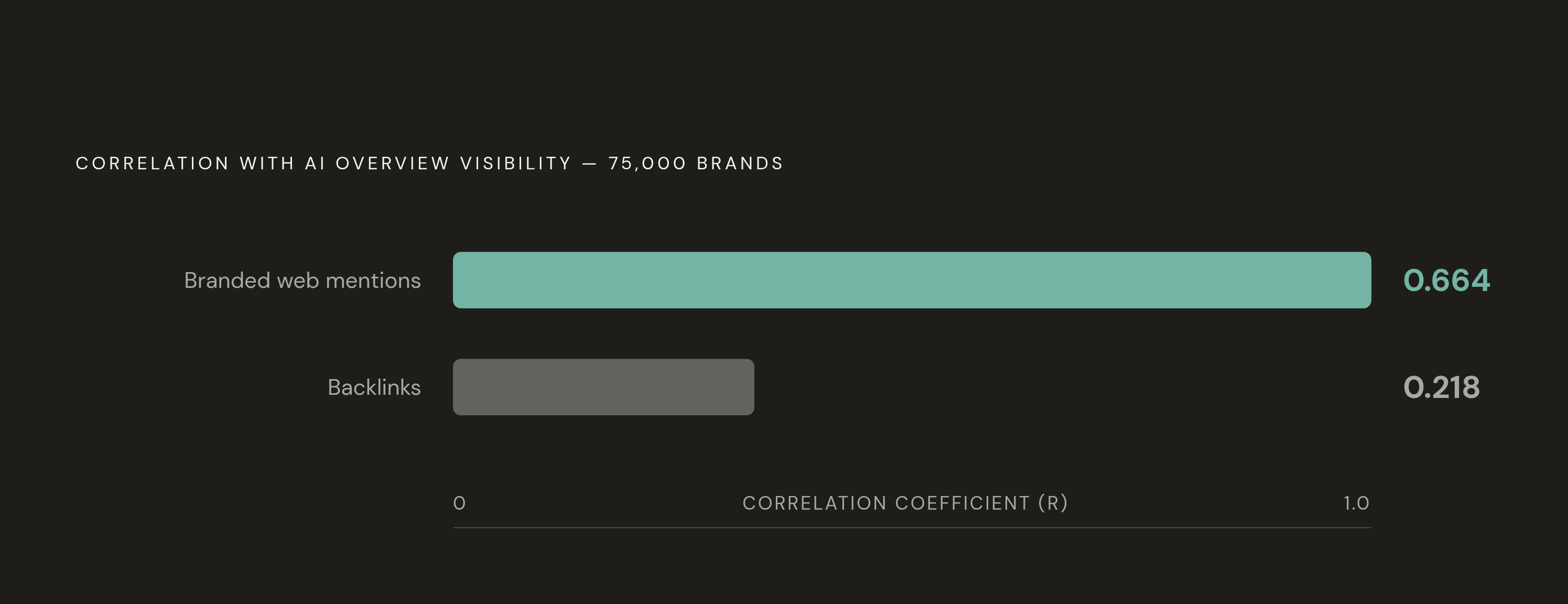
Ahrefs analyzed 75,000 brands and found that branded web mentions correlated at 0.664 with AI Overview visibility, compared with 0.218 for backlinks. Of all the signals measured, a brand’s presence on YouTube had the strongest single correlation, which covered appearances in video titles, transcripts, and descriptions. Together, these findings give marketers a reason to look beyond the backlink profile when investigating AI visibility.
The evidence does not establish cause and effect. A strong brand could explain why its name comes up often both across the web and in AI answers. No public dataset yet proves that acquiring a mention directly causes an AI system to cite the brand. Nor does a large public footprint guarantee consistent appearances. Mentions placed close to category-defining descriptions tracked AI-answer presence more closely than raw volume, with some smaller-footprint brands appearing more reliably than larger ones.
The pattern is consistent enough across independent datasets to justify tracking descriptive mentions against AI visibility over time. It does not justify treating every new mention as a purchased increment of exposure.
Why the quality and placement of a mention matters more than its volume
A mention’s value depends on what surrounds it and where it appears. Brands that appeared repeatedly in AI answers drew most of their mention footprint from third-party domains, while less visible brands leaned heavily on owned channels. How others describe a brand gives it something its own claims cannot replace. Within that description, nearby phrases such as “for small businesses,” “enterprise-grade,” and “alternative to” help establish who the brand serves and where it fits.
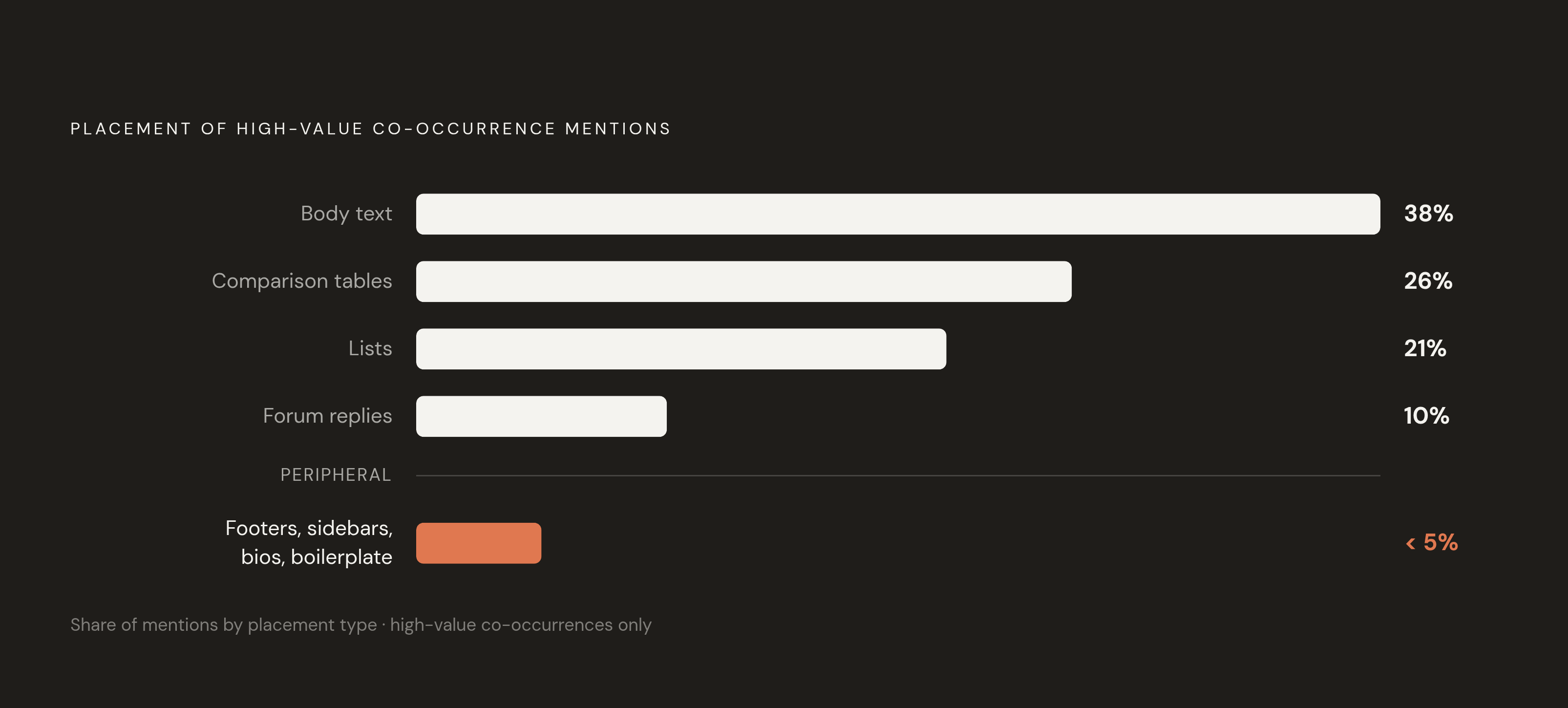
Placement separates substantive references from incidental name-dropping. Fewer than five percent of high-value co-occurrence mentions sat in footers, sidebars, bios, or boilerplate. The strongest placements were in body text, comparison tables, lists, and top-level forum replies. A mention there can explain a product’s role.
Unlinked mentions also make up most of the third-party footprint for high-visibility brands, so converting a mention into a link is a bonus. The framing still needs attention. Google uses natural language processing to interpret how a brand is discussed, including sentiment. A clear association with a customer problem is not equivalent to a passing reference or a negative comparison. A strategy that counts all three equally loses the distinction it needs to make good decisions.
Where AI answers get their sources — and what that means for brand strategy
AI systems draw heavily on community and editorial platforms, including Reddit, LinkedIn, Wikipedia, YouTube, and Forbes. These are among the most-cited off-site platforms used to assemble answers. Brands supported by third-party discussion have more opportunities to appear than brands relying on owned content alone, because much of the evidence comes from elsewhere.
Yet a brand can appear frequently in AI answers without its own pages being cited. That is the counterintuitive finding behind ghost citations. Name recognition and source selection are different outcomes, even when they appear in the same answer. A monitoring report that combines them can hide the actual problem. A brand may need source content that is easier to understand, more recognition from others, or both.
To earn citations to owned pages, teams should use clear question-and-answer structures, standalone paragraphs that can be extracted, and freshness signals. To earn brand-name mentions, the stronger focus is third-party editorial placement, comparison content, and forum presence where category language surrounds the name. These approaches can support each other. But improving a page’s extractability does not substitute for earning external recognition, just as outside recognition does not guarantee a citation to the brand’s website.
How AI answers vary by model — and why that creates a monitoring problem
A brand’s AI visibility is a distribution across engines. Perplexity may cite a brand heavily while Claude does not cite it at all. Brand stature creates broad differences too, with household names appearing more often than established mid-market or niche brands. Those patterns shift with the engine and the question. Strong results in one system cannot stand in for coverage across the others.
Prompt wording introduces another source of variation. Well-known brands that received no recommendations for a plain category question appeared when the question described a specific customer need. When the wording matched their positioning, they appeared in roughly 80% of answers. The same AI on the same day can thus show a brand far more or far less often. A generic category prompt tests only a small part of what a customer might ask.
That variability makes the measurement gap costly. Many brands appear in answers to their target queries, yet most marketers do not track AI or language-model citation visibility. Normal attribution may not reveal the exposure either, as AI-referred interest can increase branded search volume. None of this makes measurement pointless. Teams therefore need to measure with the same sets of questions, planned changes to the wording, repeated runs, and more than one engine.
What systematic AI brand monitoring actually requires
Effective monitoring starts with the questions customers are likely to ask, segmented by buyer intent. These include category questions and qualifiers such as “for [specific use case],” “vs [competitor],” “pricing,” “review,” and “worth it.” One manual ChatGPT session cannot cover that range. Its result may change with a small rephrasing or a run the following week. A useful program therefore tracks variations across models and over time.
The metrics need to capture more than appearance. Visibility records whether the brand appears, while prominence records how early and how prominently it appears. Sentiment captures how the answer describes it, and share of voice tracks its presence in category answers relative to competitors. Category leaders typically hold 25–45% share on their best engine, with challengers substantially ahead of new entrants. These gaps give teams a competitive baseline.
Changes then need to trigger attention. Useful alert thresholds include drops in visibility, sentiment that moves from positive to neutral or negative, and new competitors that reach the top recommendations for the query sets being tracked. Each points to a different question for investigation. A brand that still gets mentions but loses prominence has a different problem from one that stops appearing at all. Collapsing both into a single mention count would conceal that difference.
Lettertrace makes this discipline executable by automating prompt variations and querying ChatGPT, Claude, Gemini, Google AI Overviews, and Perplexity Sonar. It aggregates visibility, prominence, sentiment, and share-of-voice results by topic and model over time. That provides the repeated, multi-engine view the measurement problem requires. It is also permissively licensed, self-hostable, and bring-your-own-key. Monitoring data stays in the team’s own Supabase instance, with no vendor markup and no lock-in.
What to do with the signal once you have it — the feedback loop from monitoring to content
The work starts with an audit of unlinked mentions. Teams should search for the brand name in quotes and leave out owned domains to see how third parties already describe it. That baseline comes before new investment. It reveals whether the wider web describes the brand in the terms the team wants to be known for. Monitoring can then connect that footprint to the prompts where the brand appears, disappears, or trails competitors.
The next priority is the gap between customer intent and current visibility. Prompt types where competitors dominate and the brand is absent are useful content and PR targets, especially when the questions signal a buying decision. This ties spending to the revenue it could bring in while keeping mention totals from driving it. If the goal is citations to owned content, the Princeton GEO-Bench paper supports adding credible quotations, statistics, and citations. Those interventions strengthen the material an AI system can use in an answer.
Freshness belongs in that work as well. The AirOps 2026 State of AI Search report found that pages not refreshed quarterly are 3× more likely to lose AI citations than pages kept current. For brand-name visibility, the off-site priorities remain editorial comparisons, industry roundups, relevant forum threads, and video platforms. The useful placements surround the name with category context. Video transcripts and descriptions provide another place for those entity associations to form.
The next round of monitoring tests whether that spending changed the signal. Early gains in mention volume and sentiment may appear within weeks, while measurable AI-visibility shifts and backlink conversions take longer. Tracking those changes helps teams see how the work is going before they can draw firm conclusions. This applies the rigor of keyword-rank monitoring to a broader reputation problem. By earning high-quality third-party mentions in the right context, a brand strengthens the entity trust that supports both AI answers and organic search, allowing the work to compound across both channels.