

How Google AI Overviews Select and Cite Brand Sources

Google AI Overviews select and cite brand sources through a retrieval system. Earning visibility means making a brand’s answers easy to retrieve, its claims easy to verify, and its identity consistent across the web. Strong rankings alone do not do that job.
Why Google AI Overviews represent a structurally different citation system than organic search
Organic search returns a ranked set of links for a reader to evaluate. AI Overviews instead retrieve material from multiple sources and combine it into an answer. The underlying architecture is retrieval-augmented generation, or RAG. It selects passages that can support the generated response, so the unit competing for a citation is not necessarily the whole page.
That distinction changes what a strong result looks like. A useful paragraph in an otherwise unremarkable article can earn a citation, while a highly ranked page with a poorly structured answer can miss out. Because an overview usually cites multiple sources, brands compete for several source slots. Organic rank and citation selection can overlap without being the same system.
The evidence does not support treating that overlap as a simple collapse. BrightEdge’s study found that AIO citations and organic rankings overlapped more as the study went on. Yet pages outside the top 50 can still enter the citation pool, so a top-10 position is not a prerequisite or a guarantee. Google says that billions of people use AI Overviews each month across hundreds of countries worldwide. This is a separate visibility problem at a scale brands cannot dismiss.
How the RAG pipeline and query fan-out determine which pages enter the citation candidate pool
Through query fan-out, Google breaks the original question into related sub-queries, each opening another retrieval pass. The system assembles candidate passages from that wider set and then synthesizes an answer with selected citations. A page can therefore become relevant through a supporting question rather than only through the exact words the user typed.
This gives comprehensive coverage a specific role. Content that answers several related questions has more opportunities to enter the candidate pool across a query cluster. But breadth alone is not enough, because the system evaluates the passages it retrieves. Each section needs to answer a question coherently without depending on everything that came before it. An answer whose meaning lives elsewhere in the article is a weaker source for extraction.
The important distinction is between introducing a topic and answering it. A passage that states the answer directly gives the synthesis layer usable material, whereas an opening that only promises an explanation does not. This supports answer-first writing without proving that page position alone determines selection. Surfer SEO’s analysis ranked early query relevance low among the traits it examined, so it should not be cited as proof that early placement dominates.
Freshness also affects which passages are available and competitive. Citation analysis puts AIO sources at 25.7% fresher than typical organic results. As Google re-indexes pages, the retrieval pool changes even when a brand’s organic position does not.
The four citation signals that the retrieval layer weighs most heavily
Four signals help explain which passages survive retrieval and reranking, namely E-E-A-T verifiability, entity consistency, brand search volume, and semantic completeness. The system needs an answer it can use, reasons to trust its claims, and confidence about the entity behind it.
E-E-A-T verifiability makes expertise inspectable on the page itself. A byline that links to an author biography is a starting point, and Schema.org Person markup with sameAs properties that point to LinkedIn or Google Scholar adds structured data about who the author is. Citations to government data, peer-reviewed studies, and named experts give claims a traceable basis. Anonymous content lacks that route to evaluating expertise. FAQ, HowTo, and Article schema can make content easier to interpret, although controlled studies have not established a consistent causal citation lift from FAQPage schema.
Entity consistency addresses whether the system can assemble a clear picture of the brand. Its name, service descriptions, expertise claims, and terminology need to agree across its website, social profiles, structured data, and third-party mentions. Conflicting descriptions introduce ambiguity even when an individual article is strong. The Google Knowledge Graph supplies a structured scaffold for those relationships, with an accurate Knowledge Panel serving as a trust anchor.
Brand search volume supplies a different kind of evidence. Among the link-and-authority signals studied, it has the strongest measured correlation with AIO citations, ahead of backlink count. Whether increasing searches alone causes citations remains unproven. It still gives brands a reason to build recognition as part of their citation strategy, alongside getting links to build authority.
Semantic completeness is the strongest individual predictor among the content-level signals studied. A specific, self-contained answer gives the model a statement it can use and attribute. Credible quotations, statistics, and citations support that completeness and verifiability, while keyword stuffing adds no demonstrated benefit in the GEO research described. Tables, comparisons, and clearly organized lists can also make relationships easier to extract than a long explanation that leaves the answer implicit.
Why the sources Google cites most frequently are not the sources most brands are optimizing for
Ahrefs Brand Radar’s citation analysis places YouTube ahead of other domains across millions of US queries. Wikipedia and Reddit also feature prominently, while government and institutional sources receive disproportionate attention. These are different source types with different strengths, including video explanations, shared reference material, community accounts, and documented expertise. A strategy focused only on a brand’s written website leaves much of that retrieval landscape uncovered.
YouTube’s prominence matters because some queries are eligible for video sources. Strong written content does not give a brand a YouTube citation surface for those searches. Institutional authority creates a different advantage. Citation analysis finds that government sources are 11.75x more likely to be cited than average websites, and Mayo Clinic, NIH, and CDC stay in the top-25 citation positions. The pattern fits a system that values claims it can verify.
Earned media accounts for a large majority of AI citations in the analysis described, and brands are more likely to be cited through third-party sources than their own websites. That finding about AI citations broadly explains why a brand’s domain is an incomplete measure of its exposure. Editorial coverage can carry the brand into a cited source even when its own page is absent.
Community material widens the pool further. Google formally includes “Community Perspectives” from Reddit inside AIOs, making genuine participation relevant to retrieval as well as reputation. The investment gap is therefore not simply too little content. It is too much attention on one owned surface when answers draw from editorial, institutional, video, and community sources.
What citation concentration means for brands trying to enter a category where a competitor already dominates AI answers
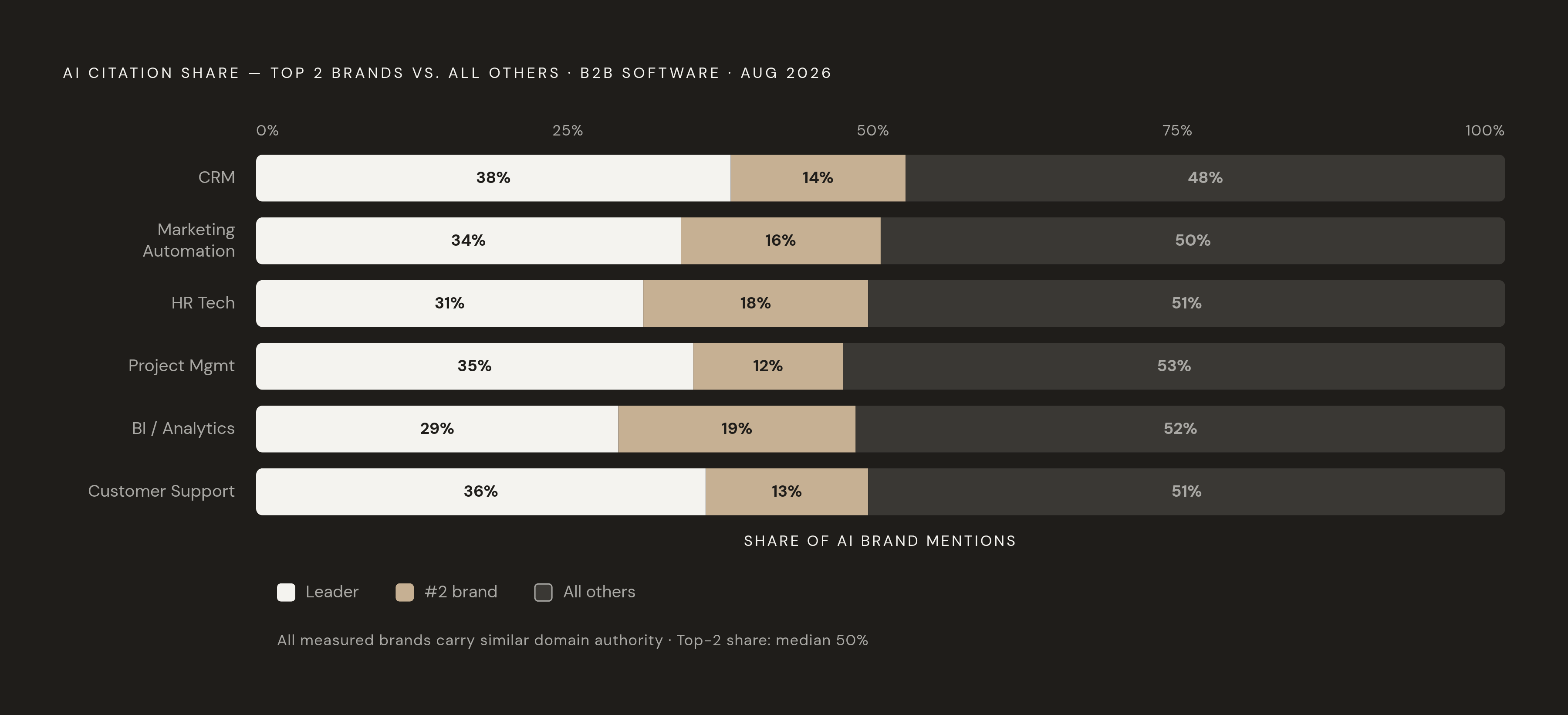
Across six B2B software categories measured in August 2026, the leading brand held a median of approximately a third of all AI brand mentions. The top two together captured nearly half or more. The brands measured had much the same domain authority, so domain authority alone could not explain the gap.
For a challenger, that concentration creates a harder problem than one missing citation. Repeated visibility can reinforce recognition, entity signals, and the likelihood that people search for the brand by name. Those are also signals associated with future citation opportunities. A competitor’s established presence can therefore compound, while an absent brand misses both current discovery and the chance to strengthen its future position. More conventional SEO work does not automatically close that gap.
Concentration does not mean the results are fixed. The sets of cited domains change a great deal from month to month in active categories, giving challengers a way in and putting leaders at risk. Position also varies sharply across engines. Only 11% of domains are cited by both ChatGPT and Perplexity, while Google AI Overviews and Google AI Mode share only a small minority of cited URLs.
A brand can consequently lead on one surface and barely appear on another. Neither strong organic rankings nor success in a different AI product establishes its AIO position. Competitive assessment needs to establish who leads, where that lead holds, and how it changes. With the sets of citations changing this much, audits done only now and then cannot show enough of what is happening.
How to measure brand citation share in AI Overviews systematically rather than by spot-checking
To track visibility over time, the prompt library needs to keep its different kinds separate. Unaided category questions check whether the brand shows up when the question does not name it. Aided questions name it directly and expose accuracy and sentiment, while comparison prompts test it against a named competitor. Attribute prompts examine a feature or capability, and use-case prompts focus on a job to be done. Keeping these groups distinct prevents branded-query success from masking weak discovery.
That distinction matters because up-funnel discovery prompts produce much lower brand citation rates than branded queries. A brand can appear reliably when someone already knows its name yet remain absent when potential customers are forming a shortlist. Each prompt also needs to run more than once on each engine because AI answers are non-deterministic.
The core metrics separate visibility from sourcing and prominence. Mention Rate is brand appearances divided by total AI evaluations, expressed as a percentage. Citation Rate is domain citations divided by total evaluations, distinguishing a named brand from a linked source. Share of Voice is brand mentions divided by total mentions for tracked competitors. AI Visibility Score sums 100 divided by mention position across evaluations, giving more weight to earlier appearances, while sentiment quality records whether the attention is favorable or damaging.
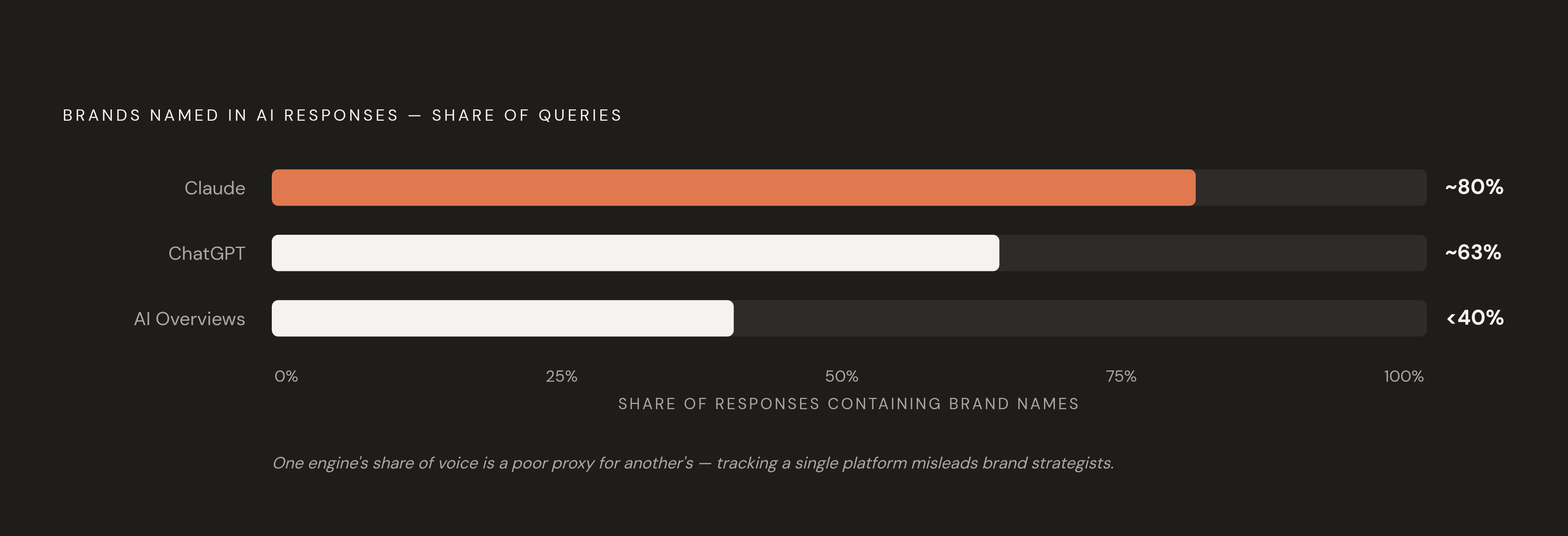
Engine-level reporting is essential because brand-naming behavior differs. Across a tracked prompt set, Claude named brands in the large majority of responses, while AI Overviews did so in fewer than half, with ChatGPT between them. Those differences make one engine’s share of voice a poor proxy for another’s. Scheduled tracking needs to preserve the distinctions between models, topics, and prompt types.
Lettertrace provides a practical implementation of that discipline. It creates prompt variations, schedules queries across Claude, ChatGPT, Gemini, Google AI Overviews, and Perplexity Sonar, and tracks visibility, prominence, sentiment, and share of voice over time. It is open-source, permissively licensed, self-hostable, and bring-your-own-key, with no API usage markup or vendor lock-in. When self-hosted, it stores data in user-owned Supabase instances.
The content and off-site actions that move brand citation share over time
Make a complete answer the first content priority by leading with a direct response to the query, then making each section coherent enough to stand on its own. Use specific claims supported by primary sources or expert evidence. Maintain existing content on a regular cadence so its usefulness does not decay as the retrieval pool changes. Deep coverage of a defined topic also gives query fan-out more relevant passages to retrieve.
The next priority is making expertise and identity legible. Use linked author biographies and appropriate Person markup, with FAQPage, HowTo, and Article schema where they fit the content. Treat structured data as a technical baseline, with no guarantee that it will bring more citations. Make sure the brand's descriptions agree across its website, Google Business Profile, LinkedIn, and structured data. Keep Knowledge Panel information accurate so those properties point to the same entity.
Off-site work then strengthens the sources and recognition that the website cannot supply alone. Earned coverage in authoritative editorial outlets gives the brand another route into the citation pool. For video-eligible categories, publish YouTube content with descriptive titles and accurate captions. Genuine Reddit participation, detailed Quora answers, and active G2 and Trustpilot profiles contribute to the community and review surfaces the system retrieves. Together, earned coverage, community presence, and video visibility can also build the brand recognition associated with branded searches.
These actions address one shared problem, which is how clearly the retrieval system can understand and support the brand from everything it finds. But publishing, updating, and earning coverage do not by themselves show whether citation share is improving. Scheduled monitoring must show which topics the brand appears in more often, which competitors gain ground, and where the brand is mentioned but no source is cited.