

GEO in Practice — Real Optimizations That Changed AI Answer Visibility

Generative Engine Optimization exists because ranking well on Google no longer means much to an AI engine deciding what to cite. A brand can sit at the top of organic search and still never appear in an answer from ChatGPT, Gemini, or Claude, because only a small share of ChatGPT citations overlap with Google's organic top-10 results.
Why GEO exists as a distinct discipline from SEO
Each of the three major AI engines pulls from its own mix of sources. ChatGPT, Gemini, and Claude don't share a playbook, so a single optimization strategy built for one won't carry over to the others. SEO also runs on a different clock. A page that ranks well can hold its spot for months or years. AI citations run on a different clock: a large share of the content cited in AI answers is recent. The shelf life of a citation is much shorter than the shelf life of a ranking.
This isn't a problem to plan for later. AI-referred sessions have grown sharply year over year, and now most B2B buyers start their research inside an AI chatbot, not a search bar. So brands need a separate practice built around getting cited, not just ranked. The rest of this piece is about which specific changes actually move that needle.
How AI engines decide what to cite
AI engines don't answer a question the way a search engine returns a list. They break the question into smaller sub-questions, sometimes called fan-out queries, and then they look for the clearest, most trustworthy source to answer each piece. A brand that only has one strong page on a topic gets picked up for one of those sub-questions, at best. If a brand has content spread across several angles of the same topic, it can get cited several times in a single answer.
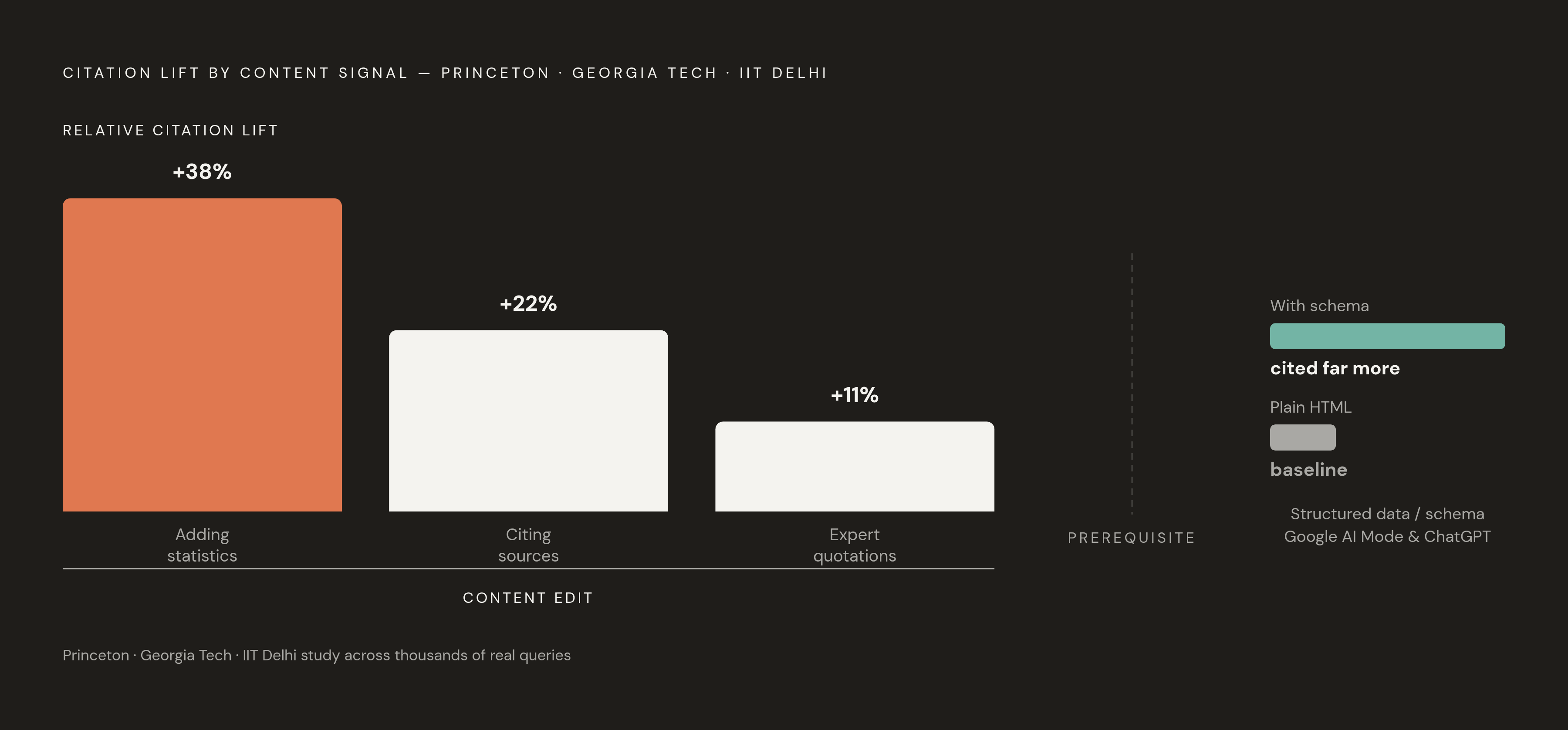
Research out of Princeton, Georgia Tech, and IIT Delhi, run across thousands of real queries, found specific edits that correlate with higher citation frequency: adding statistics, citing sources inside the content, and including quotations. Most AI citations come from outside the brand's own website. Reddit threads, review sites, Wikipedia entries, and earned press coverage outweigh brand-owned pages in the citation pool. Understanding that hierarchy, sub-question matching first, then statistics and sourcing, then freshness, then third-party weight, makes the tactics ahead make sense as parts of a single system.
Adding statistics and citations to content
It means going into a page that already gets traffic and giving its claims something to stand on, without requiring new pages, new topics, or a redesign.
The Princeton-led research backs this up with real numbers from thousands of queries: pages that added statistics saw a meaningful jump in how often they got cited by AI engines. Citing sources inside the content gave a strong lift too, especially for pages that started out ranked lower, but the effect wasn't as strong as what statistics alone produced across every page. These two edits rank among the strongest per-edit signals the research identified. The logic behind the result is straightforward. AI engines are built to hand users answers they can trust, and a claim backed by a named statistic and a traceable source is simply easier to trust and easier to cite than the same claim made with no evidence behind it. Adding quotations from named experts adds a smaller but still real lift, because a quote tells the AI that a specific person stands behind the claim.
A team doesn't need to write anything new to capture this. How the data is structured matters as much as whether it exists.
Seeklab's experience shows what this looks like once it compounds. Its citations grew faster than its brand mentions did, so the website became a cited source in AI answers before the Seeklab name itself had built comparable recognition. That's the mechanism working as intended: the content earns trust before the brand does.
Structured data as a citation prerequisite, not a technical nicety
An AI crawler has to be able to parse the page before any of the content-level work above can matter. Structured data is a gate, not a technical nice-to-have sitting at the bottom of a to-do list. Without it, even well-written, well-sourced content can be effectively invisible to an AI engine trying to extract a fact to cite.
Pages carrying structured data get cited at a much higher rate than plain HTML pages without schema, and that gap holds across both Google AI Mode and ChatGPT. The gap is wide enough that structured data works less like a ranking boost and more like a prerequisite for being considered. Three formats matter most, each for a different reason. FAQ schema helps an engine pull a direct answer to a specific question. Comparison tables give the engine a structured way to weigh options against each other. llm.txt files give AI crawlers explicit permission to access and use the content, functioning as a kind of welcome mat.
One recurring failure: plenty of sites block AI crawlers in their robots.txt file without realizing it. The Breadless franchise is a clear example of what fixing this looks like in practice: building out structured content architecture helped the brand reach a very high citation rate and a dramatic jump in Search Console impressions within a defined window.
Content freshness as an ongoing operational requirement
Once the content and the technical foundation are in place, the work doesn't stop. AI citation runs on a clock that SEO ranking never had to answer to. A page that earned a citation six months ago can lose it today, through no fault of its own, if it just sits still while everything around it keeps moving.
Citations skew heavily toward pages updated within the past year, around 68% in commercial verticals like commercial banking, with the broader rate running somewhat higher still. Pages that don't get refreshed on a regular schedule are significantly more likely to lose the citations they've already earned than pages that do. For a team that already did the work of adding statistics and fixing schema, the numbers start to drift downward even though nothing about the page got worse, and that catches people off guard. The content calendar this calls for schedules the re-optimization of pages that are already performing, before they age out of the window AI engines are willing to cite from.
Refreshing a page for GEO means more than updating a date stamp. It means swapping in newer statistics, adding fresh source citations, and expanding the page to answer new sub-questions that the AI fan-out is now generating around that topic. Teams that build a quarterly refresh cadence keep what they've earned.
Third-party source building as the highest-leverage GEO investment
The majority of AI citations don't come from the brand's own website at all. A GEO strategy built entirely around owned content, no matter how well it's written or structured, optimizes only one side of the equation.
Third-party sources collectively dominate the citation pool. Reddit threads, review platforms, Wikipedia, YouTube, and earned media coverage outweigh brand-owned pages by a wide margin. Earned media in particular, meaning press coverage, expert mentions, and independent reviews, accounts for the overwhelming majority of AI citations, while paid and advertorial content barely registers. So PR work and editorial credibility are measurable GEO assets now, not just brand-building exercises with soft returns.
The effect compounds with diversity. If brands have a presence spread across multiple third-party source types, they reach substantially higher AI prompt coverage than brands relying on any single channel, including their own site. This reframes what a GEO team actually is. Part of the job is a content discipline: writing, structuring, sourcing. Getting mentioned, reviewed, and discussed somewhere other than the brand's own domain is a distribution and PR discipline. Hone's results make the case directly. The company achieved a large increase in citation share and became the top-cited source for its relevant prompts, and that result came from building presence across external sources, not from on-site work alone.
Structuring content for entity clarity and topic authority
Topic authority in AI answers comes from how a brand's content is architected across many pages. The brand that answers the most sub-questions inside a topic is the brand that gets cited across the most queries.
This connects directly back to how fan-out queries work. Entity clarity matters just as much here. An AI engine needs to be able to tell, without ambiguity, what a brand is, what it does, and what category it belongs to. When that identity is fuzzy, citations drop even when the content itself is strong.
The audit for this is practical and doesn't require guesswork. Map out the sub-questions people are actually asking inside a topic, then check whether the brand has a page that directly answers each one; the absence of such a page marks a gap. The blank spots on that map are the actual GEO gaps worth filling, instead of a general sense that "more content" would help. Go Fish Digital ran exactly this process on its own site over three months and saw a 43% jump in monthly AI-driven traffic from ChatGPT and other AI referral sources, along with an 83.33% lift in monthly conversions from those same referrals. The approach was systematic coverage of a topic, not isolated page polishing. If a few pages inside that cluster go stale, the whole entity signal weakens, even if the main cornerstone page is still fresh and current.
Measuring what changed: share of voice, citation rate, and sentiment across platforms
None of the tactics above mean anything without a way to measure whether they worked. Share of voice, citation rate, and sentiment need to be tracked separately, and separately per platform, or a team ends up misreading the effect of every change it makes.
Share of voice isn't a single clean number. Teams need to know which of these they're tracking, because they tell different stories. ChatGPT and Perplexity cite largely different sets of domains from each other, and ChatGPT and Google AI Mode disagree on brand recommendations for the same queries at a high rate. A brand can be winning decisively on one platform and completely invisible on another, and an aggregate metric will hide that split.
Sentiment adds a third dimension that's easy to overlook. Google AI Overviews are more likely to criticize a brand than ChatGPT is, which makes per-platform sentiment tracking a requirement, not a bonus.
Getting a reliable read on any of this takes a locked set of prompts, a consistent competitor set, repeatable run conditions, and sampling that happens over and over. One-off manual checks produce noise. Scheduled, repeated monitoring reveals the real trend by averaging out the noise across runs. Semrush put this into practice by tracking its own AI share of voice and growing it substantially within one to two months, using exactly this kind of systematic prompt monitoring. The measurement setup came first, and the decisions about what to fix came after.
Teams building this kind of monitoring have more than one path. Commercial platforms offer another path, with vendors providing ways to track citation and sentiment data across engines. For teams that want to run this themselves, Lettertrace is an open-source, bring-your-own-key option that tracks brand visibility, share of voice, sentiment, and competitor benchmarking across ChatGPT, Claude, and Gemini. It's MIT licensed and self-hostable, with data stored in a Supabase instance the team owns, so no vendor holds the monitoring data and no API usage gets marked up along the way.
Putting it together: a repeatable GEO optimization loop
Every tactic covered here, statistics, schema, freshness, third-party sources, topic architecture, pays off when a team runs it inside a loop. The loop has a clear order. Start by establishing a baseline: what is the current citation rate, share of voice, and sentiment, broken out per platform and per topic cluster. Make one discrete change. Re-measure after a set interval. Attribute whatever changed to that specific edit. Then decide what to do next.
Changing one thing at a time isn't a suggestion, it's what makes the whole loop usable. A team that rolls out several GEO changes at once has no way to tell which one actually moved the numbers, which turns every future decision into a guess rather than a conclusion backed by evidence. The freshness findings covered earlier make this loop non-negotiable rather than optional: even a fully optimized set of pages will drift downward without a scheduled check back on content that used to perform well.
There's a real advantage to building this discipline early. The GEO competitive field is still thin, and brands putting in this work now are building up a citation history and a clear entity identity that later entrants will have to earn from zero. The SEOBrand case shows what the timeline for this actually looks like: an auto insurance client saw a 447% increase in AI Overview mentions, but it took six months of sustained work to get there, not a single campaign or a quick fix. Every case covered in this piece, Hone, Go Fish Digital, Breadless, Semrush, shares the same shape: a clear starting point, a specific set of changes, and a measured result afterward. That shape is the whole template. Measure first, change one thing, measure again, and keep going.