

How to Score Sentiment in AI Answers When the Model Hedges Everything

Scoring sentiment in AI answers means measuring how strongly a model backs a brand. For teams that work on answer engine optimization and GEO, qualifier density, confidence framing, and recommendation strength are the signals to track. Teams need to test those signals again and again and calibrate them for each engine. Otherwise, a polite answer that steers buyers away can pass as neutral.
Why standard sentiment scoring fails on AI-generated brand answers
A buyer asks ChatGPT to shortlist CRMs. The answer describes one brand as “worth considering if” its features match the buyer’s needs, then gives a competitor a direct recommendation. A standard sentiment classifier scores the first description as neutral. The model has placed a condition on one brand while endorsing another, without using an openly negative word.
Traditional sentiment tools look for emotional markers such as “love,” “terrible,” and “amazing.” Those markers work differently in a customer review, where a person is expressing an opinion, than in an AI answer synthesizing perceptions from training data. AI models show which brand they favor through qualifiers, assertion strength, and competitive positioning. The sentiment is in the structure of the answer. A classifier looking mainly for emotional vocabulary can mistake a brand mention for an endorsement.
Luka Terčon and Kaja Dobrovoljc’s 2025 Linguistic Characteristics of AI-Generated Text: A Survey identifies a more formal, impersonal style among the most commonly reported characteristics of AI prose. It describes greater use of nouns, determiners, and adpositions, with less reliance on adjectives and adverbs. That leaves less emotional vocabulary for conventional tooling to read. A restrained answer is not necessarily an impartial one.
How hedging works as AI's default register — and what it actually signals
Hedging is part of AI’s default writing register. Phrases such as “may be suitable for,” “some users find,” and “worth considering if” limit how firmly the model stands behind a claim. They offer approval with an escape clause. By contrast, “known for,” “widely regarded as,” and “consistently delivers” present a claim with less reservation. The contrast reveals how much confidence the answer asks a buyer to place in the brand.
Not every hedge performs the same job. “Might be” signals uncertainty, while “some users find” places responsibility for the claim elsewhere. A contrastive concession goes further. A construction such as “while it offers X, users note Y” acknowledges a benefit before directing attention to a drawback. These forms can all sound measured, but they do not give the buyer the same reason to proceed.
ChatGPT produces narrative comparisons, while Claude’s careful, nuanced prose tends to avoid amplifying strong positives or negatives. Gemini uses multi-source generative summaries with an emphasis on entities, recency, and structured data. Perplexity’s answers are more citation-led, making source quality and freshness part of the framing. There is no useful assumption that every engine expresses endorsement in the same way.
The source of the answer creates another distinction. Static framing comes from training data and changes slowly, while dynamic framing comes from retrieval and can shift with new content within days. ChatGPT can use real-time web retrieval via Bing when live information is needed, so its answers cannot all be treated as training-only output. A hedge may come from a view the model already holds or from material it has just retrieved.
Why a single prompt run gives you noise, not a sentiment reading
A single prompt run is an observation. The same prompt run five times can give different answers, so one unusually warm or cautious answer cannot show where the brand stands. Frequency across repeated runs provides the useful signal. Before applying a scoring framework, a team needs a declared set of prompts and a fixed schedule. Without that measurement contract, a change in the score may just come from a change in what was asked.
Prompt choice determines which perceptions can surface. “What are project management tools?” asks for a category description, whereas “What do people think of [brand]?” asks the model to synthesize opinion. “What are the complaints about [product]?” draws out criticism that a feature summary may leave untouched. Neither prompt type substitutes for the other. Comparisons over time need a stable mix rather than whichever question seems interesting that week.
The practical requirement is to repeat that declared prompt set across engines while controlling or declaring personalization, geography, and enterprise context. Score ChatGPT, Claude, Gemini, and Perplexity separately. If results are later combined, their weights must be stated, because an unexplained average hides differences in both style and response frequency. Otherwise, the framework will precisely score inputs that cannot fairly be compared.
A scoring framework that treats qualifier density and recommendation strength as the primary signals
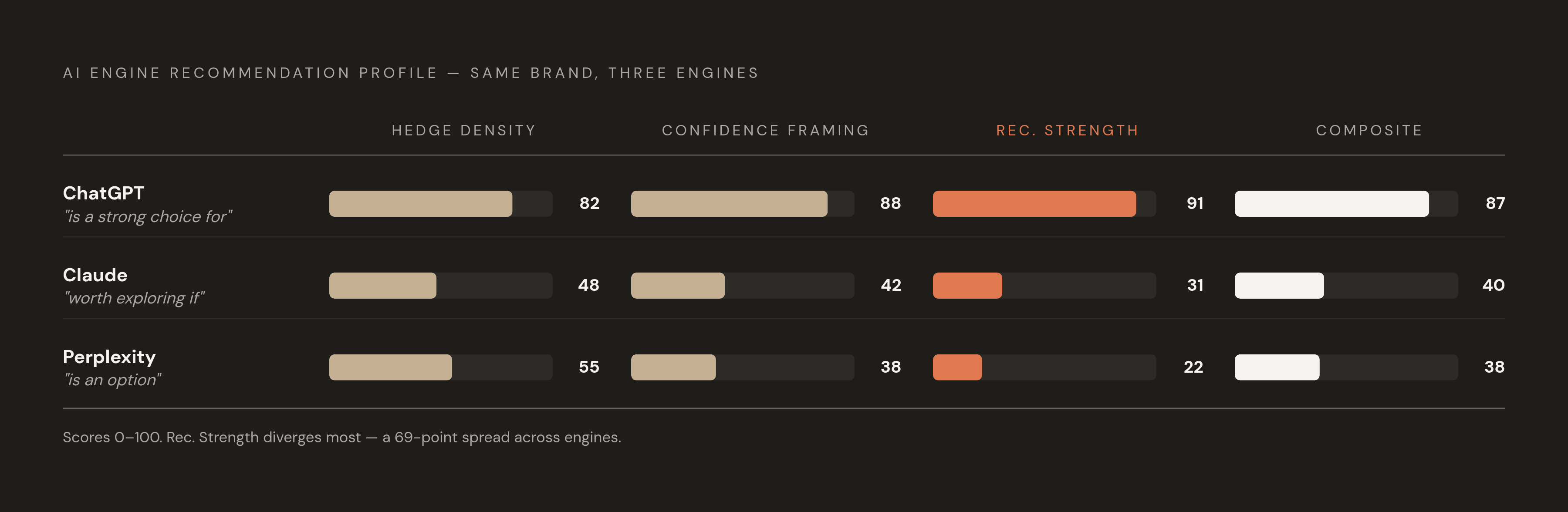
To use the framework, score each passage that describes a brand on three separate axes before working out a composite. The axes are qualifier density, confidence framing, and recommendation strength. Keep them visible in the results. A single total cannot show whether a score fell because the model added caveats, deferred to other sources, or stopped recommending the brand. Recommendation strength should have the most weight, while qualifier density should help support the score.
Consider three made-up descriptions of the same software brand. In the ChatGPT version, the description uses “known for” and concludes with “is a strong choice for.” In the Claude version, it uses “some users find” and ends with “is worth exploring if.” In the Perplexity version, it uses “described as,” organizes its case around citations, and ends with “is an option.”
First, count hedging constructions within the brand passage and classify their form. Include possibility modals such as “may,” “might,” and “could,” reported claims such as “some users report,” and conditions such as “depending on your needs.” The suggested bands to start with are low density at 0–1 hedge per sentence, medium at 1–2, and high at 2+. These bands overlap at their endpoints. Before scoring, declare how boundary cases will be assigned, then calibrate the bands for each engine.
On this axis, the made-up ChatGPT passage has a low-density positive signal because neither of its phrases adds a condition. The Claude passage uses both attribution and conditional approval, so its signal is more cautious, and its final band depends on how many sentences it has and the baseline for that engine. The Perplexity passage needs its source-led attribution distinguished from uncertainty. Count the construction, but preserve its type. A possibility modal is weaker negative evidence than reported-speech hedging, while a contrastive concession is the strongest negative structural pattern in this framework.
Next, score confidence framing by asking whether the model endorses the claim or defers. The ChatGPT passage’s “known for” is a confident assertion and therefore a positive signal. The Claude passage combines an attributed claim with a conditional recommendation, so its framing is more reserved. The Perplexity passage’s “described as” is attributed rather than direct, placing that assertion in positive or neutral territory depending on its context. Competitive placement also belongs here, because appearing as “also worth considering” is weaker than being the named recommendation even when the description sounds favorable.
Then score the conclusion for recommendation strength. The ChatGPT example receives a positive reading for its direct recommendation, the Claude example a weaker reading for its conditional recommendation, and the Perplexity example a neutral-listing reading from the conclusion alone. Citation prominence may change the Perplexity assessment during engine calibration. The ending deserves extra weight. A direct recommendation can outweigh moderate hedging in the body, while a closing warning about a learning curve can outweigh earlier praise.
Finally, calculate each mention’s composite by summing the three dimension scores with declared weights. Combine those results for each engine using net sentiment, which is the number of positive-scoring mentions minus the number of negative-scoring mentions, divided by the total number of mentions. Record absence from a competitor list as zero recommendation strength, and keep it distinct from the mention-based calculation. Preserve a drill-down from brand to prompt to AI response to answer attribute. That path makes a score change traceable to the language or placement that caused it.
Calibrating the framework per engine rather than applying universal thresholds
Calibration starts with category prompts about well-understood brands that have independent evidence of sentiment, such as strong review profiles or an established reputation. Run the framework against those answers and adjust thresholds until the scores align with that evidence. A level of hedging that is routine for one engine may represent unusual caution in another, so importing a threshold can turn writing style into a false brand penalty.
Adjust the linguistic triggers as well as the density bands. Gemini’s structured summaries may show recommendation in a different way from narrative comparisons, while Perplexity may show it through the sources it chooses and the order of its citations in place of a direct endorsement. For that reason, citation prominence can serve as a recommendation proxy in its scoring. Re-baselining schedules also need to reflect the answer’s source. Retrieval-led framing can change within days, while framing drawn from ChatGPT’s training data needs to be tracked over a longer time.
Using share of voice alongside sentiment to tell the difference between invisible and present-but-damaged
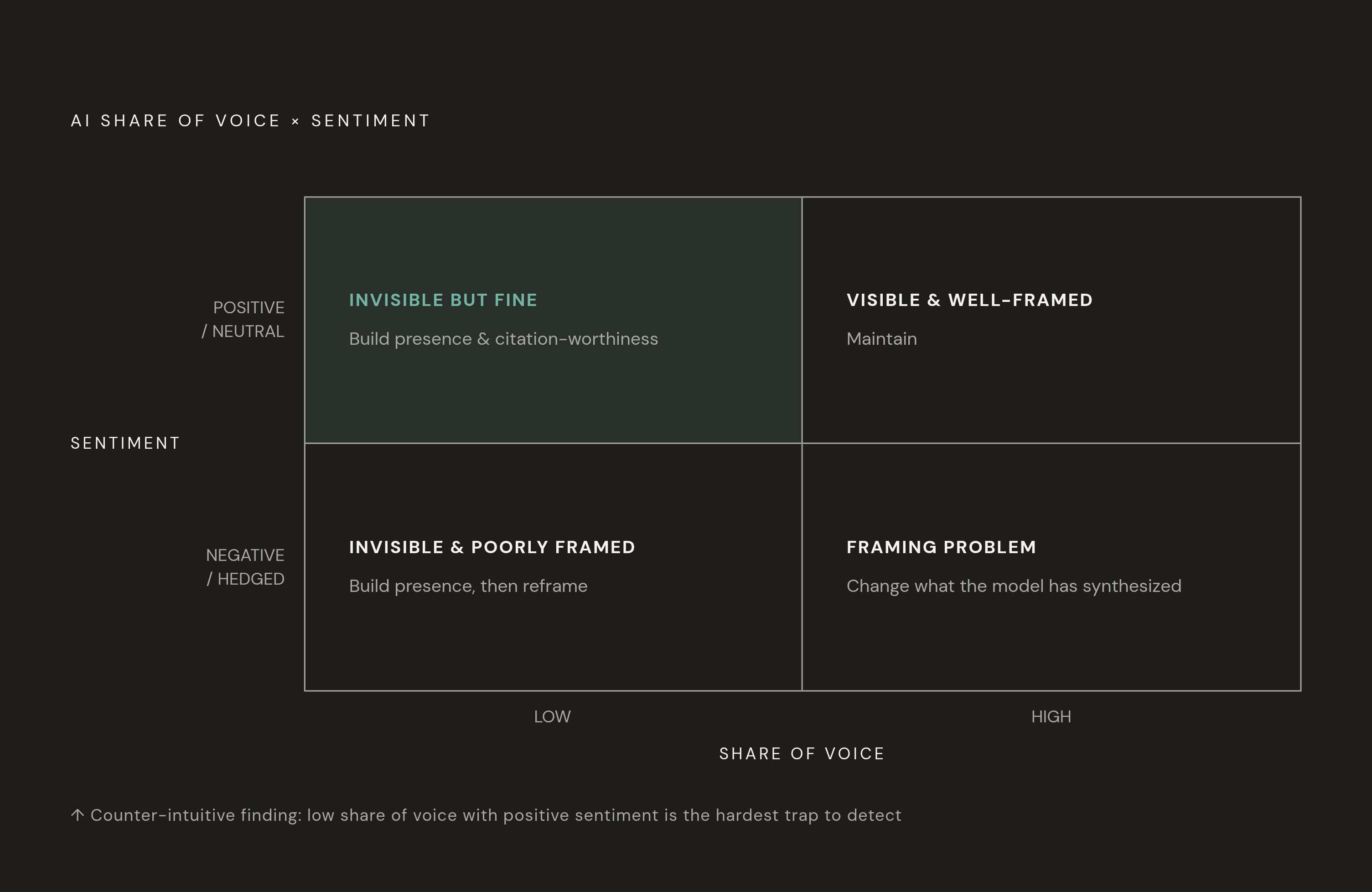
Sentiment alone cannot distinguish absence from poor treatment. AI share of voice is the percentage of relevant brand mentions a company receives relative to all category brand mentions within a declared prompt universe. It supplies the missing context. Low share of voice with positive or neutral sentiment points to an invisibility problem, while high share of voice with negative or heavily hedged sentiment points to a framing problem. The former calls for greater presence and citation-worthiness, while the latter requires changing what the model has synthesized.
Competitor benchmarking makes that distinction more useful than raw visibility. Appearing often is less reassuring if a competitor appears much more often in the same responses. Equally, a competitor with lower share of voice but consistently stronger recommendations presents a different challenge from one with broad visibility and mixed sentiment. Track both axes together. Otherwise, a team can mistake frequent, cautious mentions for a strong competitive position.
Lettertrace provides a practical way to organize that measurement. It automates prompt variation, multi-model querying, and aggregation into brand visibility, share of voice, prominence, sentiment, and competitor benchmarking over time. Results are grouped by topic and model. That helps teams follow the measurement contract instead of checking by hand now and then, though they still need the calibration described above to read the scores. Its self-hosting is available under a permissive license and keeps the data in the team’s own Supabase instance.
What the framework's output should actually change — connecting scores to content and positioning decisions
The scores become useful when they point to specific content and positioning changes. For a team seeing high qualifier density, the first intervention is narrative consistency across indexed surfaces. Conflicting descriptions on the brand’s site, LinkedIn, Crunchbase, and a podcast bio can leave the model with weaker evidence of what the brand represents. Consistent, repeated, authoritative descriptions give it a clearer basis for its claims. This is not simply a request for more content.
Weak recommendation strength calls for a different response. Thin third-party coverage can leave the model without enough independent support to endorse a brand, so the intervention is earning citations and structured comparison coverage. Perplexity cites brand-owned sources less often than independent sources, while Claude favors brands whose information is well structured and well documented. Brand-owned content still has a role. Credible quotations, statistics, and citations can increase its citation-worthiness and the chance that an answer draws from that framing.
Concessive answers need a closer diagnosis before content changes. Sentiment-revealing prompts such as “what are the criticisms of [brand]?” can identify the negative associations behind a recurring “while” clause. If those associations reflect outdated or one-sided coverage, content can address the imbalance. The response should follow the specific association. Adding general praise does not address the reason an answer keeps qualifying its recommendation.
Track the results on the fixed cadence already established, allowing for faster retrieval-driven changes and slower training-data shifts. As AI assistants become a primary discovery channel, teams that build this discipline can accumulate a clearer record of which perceptions change and which interventions help. That gives them a compounding advantage over teams still treating an occasional polite answer as proof that the brand is doing well.