

Is Training Data or Live Retrieval Deciding Whether ChatGPT Names Your Brand

Whether ChatGPT names a brand depends on two things, training-data associations and live web retrieval. They respond to different signals and change on different schedules. The balance is also shifting, especially for questions about prices, comparisons, and current recommendations. Brands need to monitor both layers continuously.
How two separate mechanisms produce ChatGPT's brand answers
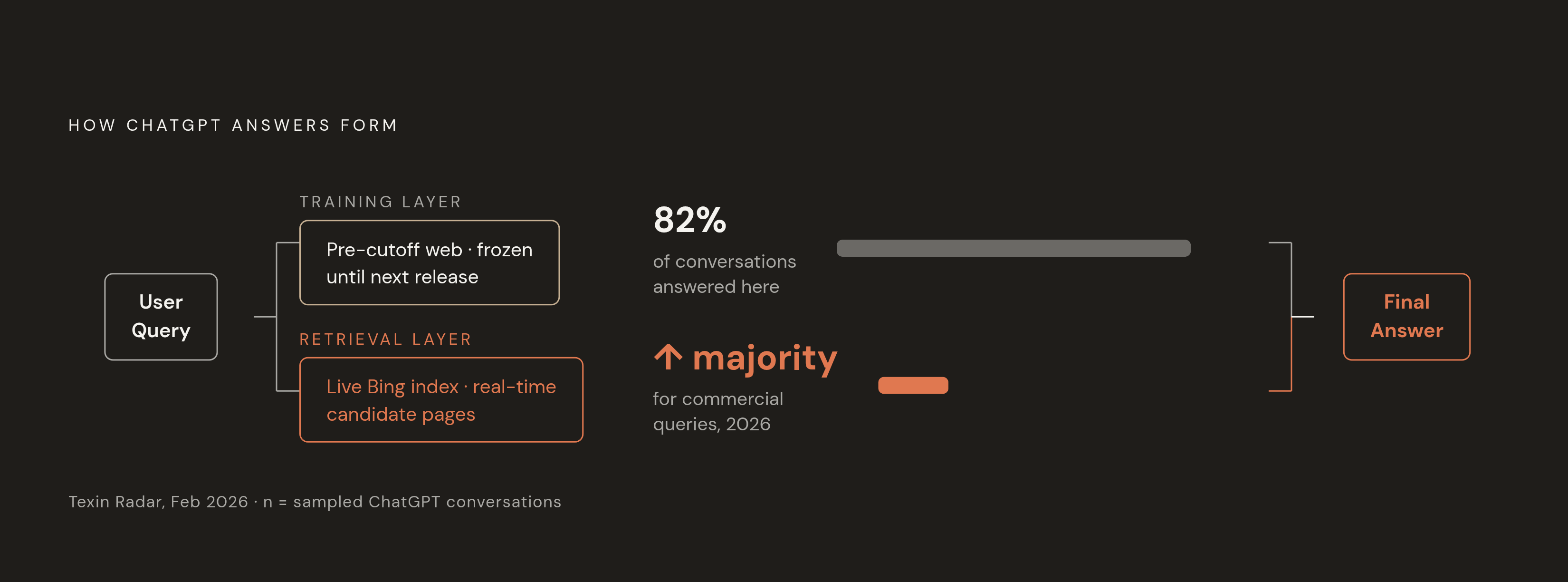
ChatGPT can name a brand without searching the web. Its training layer holds associations learned from content that was available before the model’s training cutoff, including which brands belong to which categories. When a question draws on those associations, the answer comes from knowledge built into the model.
Live retrieval follows a different path. When a question triggers search, ChatGPT draws on a primarily Bing-aligned search index, reads candidate pages, and builds an answer from retrieved material. A brand can therefore be familiar to the model yet absent from its search sources, or appear in current sources despite weak training associations. These are separate routes into the same answer. Their different clocks explain why changing a web page can help one route while leaving the other untouched.
Why the training layer is both powerful and largely out of a brand's direct control
Texin Radar’s February 2026 analysis found that 82% of ChatGPT conversations got answers based only on training data. That gives training associations enormous influence over brand exposure. Those associations come from how often a brand was mentioned on the web, how consistently it was linked to its category, and how widely authoritative sources covered it. A single owned channel is not the whole foundation.
Yet brands cannot change the model’s internal weights themselves. Publishing corrected pricing or a new category description does not rewrite knowledge already baked into a released model. The training corpus stays fixed until the next release cycle, which can be months away. Meanwhile, memory-only answers can repeat stale positioning, old prices, or incorrect claims without a live check.
The ora research paper on agent experience, or AX, found that training knowledge supplied only a small fraction of finished answers when live retrieval was available. Its influence depends on both whether search fires and how well the model knows a brand.
How fast the retrieval layer is growing as a share of ChatGPT answers
Texin Radar’s analysis documented a sharp shift across ChatGPT generations in 2026. Runs firing a live search anchored to the current year rose from a small minority to a large majority within months. That is a narrower observation than the overall conversation figure. It shows why an aggregate measure can conceal a major change in commercially important questions.
Local recommendations, category comparisons, pricing questions, and prompts with recency signals are especially likely to trigger retrieval. These are questions where a buyer may be choosing between brands. Search frequency is only part of the change. The mix of questions being searched also affects which brands get considered.
The October–November 2026 GPT-6 fan-out study covered tens of thousands of matched questions and found sharply more cited URLs after the transition. It also found more recency modifiers and a shift toward review and pricing searches. Those findings put fresh retrieved content closer to the buying decision. Tracking training associations alone misses that exposure, while tracking retrieval alone misses memory-based recommendations.
What the retrieval layer actually selects and why it differs from Google ranking
Seer Interactive’s February 2025 study found that most ChatGPT citations matched Bing’s top organic results, with only a small share matching Google’s. The median Google rank for cited pages sat well outside the first page. Google rankings are therefore a poor substitute for measuring ChatGPT exposure. A strong search position in one index does not establish presence in another.
Bing gives weight to explicit, declarative content, social signals, and third-party review profiles in ways that differ from Google. Pages tuned heavily for Google can underperform in Bing. An existing SEO program may help, but it does not demonstrate that ChatGPT retrieves the brand.
OpenAI’s crawler documentation states that sites blocking OAI-SearchBot will not appear in ChatGPT search answers, although they can still appear as navigational links. Retrieval cannot be treated solely as a content-quality contest when crawler access can exclude the site from that route.
How agent-readiness of a brand's own site determines whether retrieved facts are used or discarded
AX describes whether an AI agent can fetch and understand a business’s own pages after finding them. This sits between retrieval and the final answer. A page can clear the discovery step but still fail to supply the facts the buyer asked for.
The ora paper ran tens of thousands of agent journeys across more than a thousand real businesses. It found that agent-ready businesses had answers built from their own pages in a large majority of cases, against a substantially lower rate for other businesses. They were recommended at nearly twice the rate. Answers grounded in readable first-party pages were also more accurate on average than those relying on third-party sources alone.
The dominant failure was omission. AI crawlers generally do not execute JavaScript, so content assembled after page load can be invisible, while heavily visual layouts may leave little readable text. The same study found that grounded answers about non-agent-ready sites cost agents substantially more to produce. That could create an incentive to deprioritize difficult sites, although it is not proof that engines already do so.
Why ChatGPT, Claude, and Gemini produce different brand answers for the same query
ChatGPT, Claude, and Gemini do not offer interchangeable views of a brand. Their training corpora, retrieval architectures, and patterns of factual error differ, so performance on one cannot stand in for the others. A strong result in ChatGPT says little by itself about whether Claude will name the same brand. There is no universal answer list.
ChatGPT’s retrieval is anchored in Bing, while Gemini combines training knowledge with live Google Search. Gemini’s grounding is selective rather than always on, with an emphasis on authority signals and structured data. Those differences affect which evidence can enter an answer. They also affect whether an outdated training association gets challenged by fresh information.
BrightEdge research found that ChatGPT and Google AI Overviews disagreed on brand recommendations for a large majority of identical queries. That comparison concerns Google AI Overviews and illustrates the danger of treating one engine as representative of others such as Gemini. The monitoring implication is direct. Each engine needs its own record of mentions, sources, and accuracy rather than being folded into a single undifferentiated result.
Why prompt phrasing and query type shift which layer fires — and which brand wins
A year or a term such as “current” or “latest” almost always triggers retrieval, while an evergreen question such as “best tool for X” may not. The model version and query type influence that decision too.
A useful monitoring frame separates direct brand queries, category queries, and problem-focused prompts. Direct questions reveal what the assistant says about a named business. Category questions reveal whether it includes the business without being asked, while problem-focused questions show whether it connects the brand to a need. Comparison questions also show which other brands appear together.
Each tier also needs questions phrased in different ways, because small changes in wording can lead to different lists of brands. A synonym can expose a gap hidden by the original prompt. Sentiment needs the same care, since asking about downsides produces a different framing from asking for a recommendation.
How Reddit's citation collapse illustrates the retrieval layer's volatility
Reddit’s share of ChatGPT citations fell quickly to almost nothing, showing how fast retrieval sources can change. Brands with most of their third-party mentions in Reddit threads lost retrieval exposure almost overnight. Their earlier mentions did not need to disappear from the web for that loss to happen. The selection of sources had changed.
Training presence could survive the same disruption. A model could still associate a brand with its category while its retrieved answers stopped drawing on the threads that previously supported recommendations. That is the two-layer split made concrete.
The divergence also extended across engines. Google AI Mode maintained a substantially higher Reddit citation share than ChatGPT Search in November 2026, so the same concentration of mentions produced different exposure. Reliance on one third-party platform was fragile even when it had previously been heavily cited. Detecting that shift requires continuous tracking across sources and engines.
What share of voice in AI answers actually measures and why it differs from SEO metrics
AI Share of Voice measures a brand’s presence in synthesized answers across a defined prompt set. It concerns whether the assistant names or recommends the brand, while search rankings concern where a page sits in search results. That distinction changes the unit being measured. Search visibility shows what evidence an answer could use, while answer visibility shows what made it into the response.
The denominator needs to be explicit. The percentage of responses mentioning a brand measures answer coverage, while the brand’s portion of all brand mentions measures its relative share. Both can describe visibility, but they answer different questions. Neither can be inferred reliably from domain authority or Google rankings.
Citation share is distinct from mention share. A brand can be named without its own pages being cited, and a page can supply evidence without its brand becoming a recommendation. Sentiment adds another dimension, because a cautionary mention is not an endorsement. Google Search Console’s Generative AI performance report supplies impressions for Google’s AI Overviews and AI Mode.
Why one-off manual prompting fails as a monitoring strategy and what systematic tracking requires
A manual prompt captures one answer under one set of conditions. It cannot reveal whether a different phrasing, engine, or model release would change the result. Repeating it now and then still leaves gaps between checks. The sources can change during those gaps, as they did with Reddit.
A systematic program needs a fixed prompt set across intent tiers, phrasing variations, and scheduled repeated runs. Results need to stay separate for each engine, with checks for sentiment and accuracy alongside how often the brand is mentioned. Competitive gap analysis adds where other brands appear and the target brand does not. Manually preparing, running, and comparing all those checks is prohibitive for most teams.
Lettertrace addresses that operational workload. It automates prompt variation, queries ChatGPT, Claude, and Gemini on a schedule, and aggregates visibility, prominence, sentiment, and share-of-voice metrics by topic and model. It is open-source, bring-your-own-key, and self-hostable, with data stored in a user-owned Supabase instance. The product is free end-to-end with no usage markup, while users pay model providers directly.
Data ownership has a practical purpose here. Monitoring records show how a brand stands against its rivals and what its content strategy is, so self-hosting keeps those records from depending on a vendor’s proprietary data store. The value is a comparable record of how exposure changes.
The content and entity signals that move a brand's presence in both layers simultaneously
The foundation for both layers is an unambiguous brand identity. The recommended approach is one consistent name, category description, and set of key facts across the site, directories, review platforms, and press materials. Independent reviews, coverage, comparisons, and community mentions add corroboration beyond owned pages. Those mentions can support retrieval now and training coverage in future model versions.
Answer-ready content strengthens that foundation. The Princeton GEO paper found that quotations, sourced statistics, and cited references substantially increased AI visibility in controlled tests, while keyword stuffing was harmful. On the brand’s own site, plain HTML, answer-first structure, and content independent of JavaScript rendering help agents use first-party facts. Bing Webmaster Tools verification, sitemap submission, and OAI-SearchBot access support the retrieval path alongside those content signals.
None of these investments makes the balance between layers stand still. Continuous measurement shows whether the work is producing accurate mentions and recommendations. Brands that treat AI visibility as a measurement discipline, rather than a finished content project, are positioned to catch those shifts in time to respond.