

Self-Hosted AI Brand Monitoring Tools That Cover All Three Major Models

Self-hosted AI brand monitoring is about measuring what ChatGPT, Claude, and Gemini say about a brand without handing the monitoring history or budget to another vendor. Teams schedule queries across all three and store the results in infrastructure they control. For continuous monitoring, that setup removes usage markups and preserves the baseline needed to judge whether changes work.
Why AI assistants have become a primary brand discovery channel
AI assistants now serve as a primary research interface for buyers. Instead of returning a ranked page of links, they synthesize an answer that names some brands and leaves others out. That changes the competitive ground. A brand can rank well in traditional search yet be absent from the answer a buyer reads. Visibility is winner-takes-most within the response, while positions on a search page differ more gradually in how much they get seen.
SEO gets a page discovered, answer engine optimization, or AEO, gets an answer extracted from it, and generative engine optimization, or GEO, gets a brand recommended. These are different outcomes. Search remains the starting point, but discovery alone does not establish whether an assistant recommends a product or describes it accurately. Teams need to measure the answer itself.
How ChatGPT, Claude, and Gemini each surface brand recommendations differently
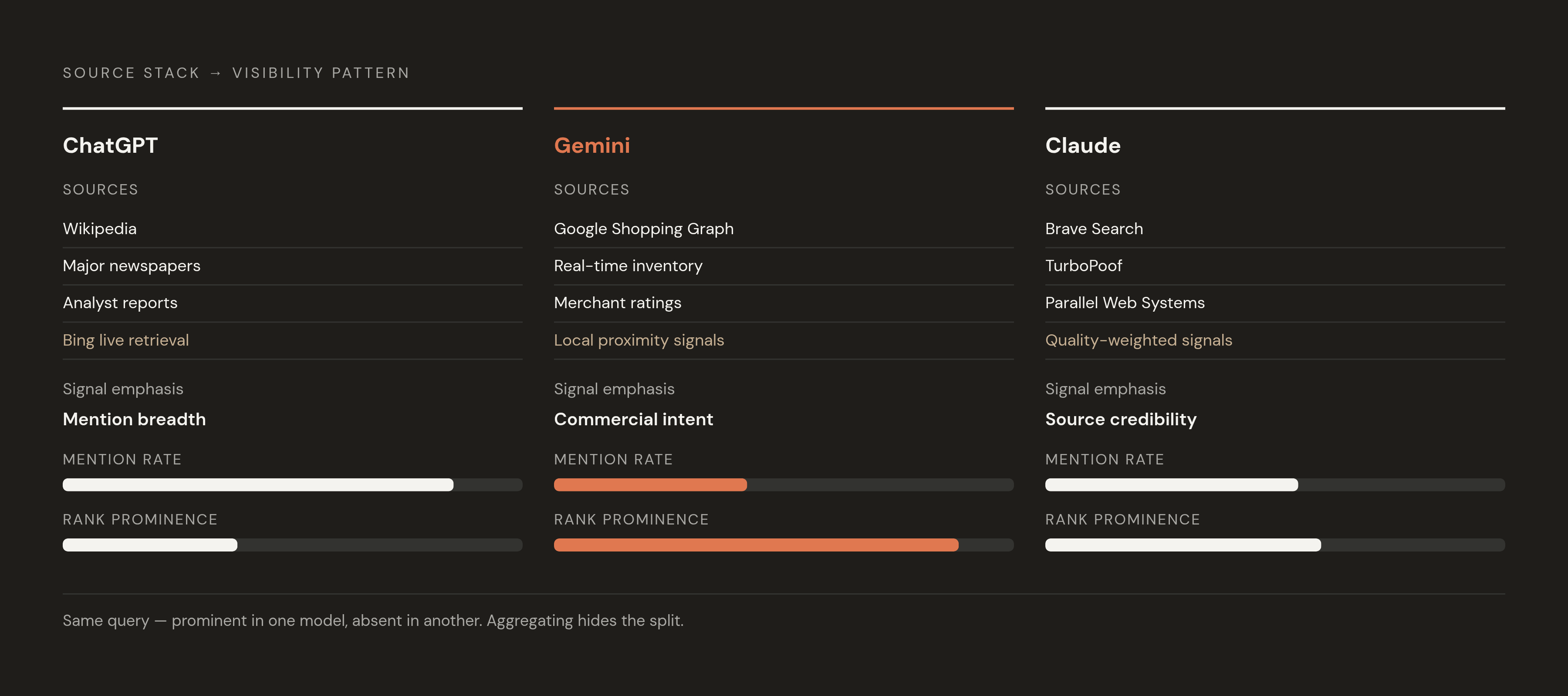
ChatGPT draws on both a training-data prior shaped by high-authority sources, including Wikipedia, major newspapers, and analyst reports, and a Bing-fed live retrieval layer. Its recommendations are probabilistic across both stages, with no documented “confidence score.” It mentions brands across a relatively wide share of queries, but a given brand often appears several positions into the response.
Gemini puts more weight on commerce signals. Its integration with the Google Shopping Graph and real-time inventory signals makes verified merchant ratings, local proximity, and in-stock status relevant to recommendations. It mentions brands in a smaller share of queries, but those it names tend to appear near the top.
Claude uses Brave Search as its primary web index, together with TurboPuffer and Parallel Web Systems, in place of Bing or Google. Its source mix creates a different visibility profile, and its quality-sensitive approach can give one credible source more weight than many thin ones. What buyers see thus depends on whether a brand is in the indexes and sources each model uses.
Those differences rule out treating one model as a proxy for the others. The same query can produce a prominent recommendation in one assistant and no mention in another. An aggregate can hide that split. Share of voice needs to be measured per model, using the same prompt set, because true AI visibility cannot be established without querying all three.
What systematic, multi-model monitoring actually requires
A single answer is not a reliable measurement. The same prompt on the same model can return different brand mentions on successive runs. Monitoring therefore requires repeated queries over time. The unit of work is a prompt library built around the buyer questions in which a brand should appear. Keeping that library in order lets teams compare runs of the same prompts.
A minimum viable library covers informational, comparative, and transactional intent. Informational prompts ask what tools exist for a need, while comparative prompts ask how the top options compare. Transactional prompts ask which tool a particular buyer should use. These questions test different stages of consideration. Together, they distinguish basic recognition from competitive positioning and direct recommendation, so a team can see where visibility breaks down.
Mention rate is the share of runs in which a brand appears, while citation rate is the share that cite a brand-owned URL. Recommendation rate measures active suggestions for the buyer’s need. Sentiment, factual accuracy, competitor framing, and share of voice show more about what the answers say than how often the brand appears. Cited URLs also need to be separated into brand-owned, competitor-owned, and third-party sources.
More mentions are not automatically a good result. Wrong pricing, discontinued products, or complaints from forum threads can make buyers less likely to consider a brand even when it appears often. Teams must keep raw responses so they can read those descriptions as well as the score. With three models, several intent types, and repeated runs, the number of answers grows quickly. This requires a schedule and automation.
Why managed SaaS tools create structural problems for this kind of monitoring
Managed tools are legitimate choices for one-off audits or teams without engineering resources. They are faster to start and require no infrastructure. The friction appears when monitoring becomes continuous and high-volume. A managed platform sits between the team and the model APIs and adds its own charge to raw API costs. Each time the team repeats a query to track a trend, it pays that markup again.
The database creates a separate constraint. Monitoring records which competitors get recommended, how the brand is framed, and which sources shape the answer. That is strategically sensitive information. In a managed setup, it sits in the vendor’s database. Prompt libraries, historical responses, and trend data can also be difficult to move, putting the baseline at risk when the team changes providers.
Coverage is another decision the team does not control. A vendor may not support a model or may remove it from a plan, leaving the monitoring program with a gap. Simplicity is the strongest argument for accepting these limits. For systematic monitoring at scale, however, self-hosting shifts the trade-off toward an upfront setup investment rather than recurring usage margins and dependence on a vendor’s coverage decisions.
What self-hosted architecture for multi-model monitoring looks like in practice
A self-hosted setup has three layers for scheduling, storage, and reporting. The scheduler runs the prompt library across all three model APIs on a cron schedule. A background worker repeats each prompt multiple times per day and captures the raw response text with the model, timestamp, and prompt ID. Repetition supplies the evidence for a rate. The metadata ties each answer to the question and model that produced it.
Bring-your-own-key access removes the monitoring platform from the billing path. The team supplies its own keys for the ChatGPT API, Claude API, and Gemini API and pays raw API rates without a monitoring vendor’s markup. The model providers still receive the queries. Self-hosting means the outputs do not also pass through a separate monitoring vendor’s server, and the stored monitoring record remains under the team’s control.
The storage layer keeps raw outputs and computed metrics in a database the team owns. PostgreSQL and ClickHouse are common choices in these tools. This is where the historical baseline lives. From those responses, a derived-metrics layer computes mention rate, citation rate, recommendation rate, sentiment classification, per-model share of voice, and competitor co-mention frequency. Reporting then makes those measurements usable as trends and competitive benchmarks.
Lettertrace implements this architecture as an MIT-licensed, self-hostable tool. It schedules queries to ChatGPT, Claude, and Gemini with user-supplied API keys and stores results in a user-owned Supabase instance. Its reports show visibility, share of voice, sentiment, and competitor benchmarking over time. There is no usage markup or vendor-held monitoring database. It is a concrete example of how scheduling, owned storage, and reporting fit together without a managed platform between the team and its results.
Open-source tools that cover all three major models, and what each one emphasizes
The open-source landscape differs on more than engine count. The useful comparison includes default model coverage, query method, storage ownership, and which metrics are computed natively. Lettertrace’s emphasis is a focused three-model workflow with scheduled API queries, Supabase storage, and built-in trend reporting. Its MIT license permits a self-hosted setup without a software license fee. Teams still pay for the API usage generated by their keys.
Elmo takes a broader engine approach. The MIT-licensed AEO platform covers ChatGPT, Claude, Gemini, Perplexity, AI Overviews, AI Mode, Bing AI Mode, Grok, DeepSeek, Mistral, Qwen, Kimi, and all OpenRouter LLMs. A background worker runs each prompt several times a day and saves raw responses in a PostgreSQL instance the user owns. Its dashboard reports visibility, share of voice, sentiment, and citations. It also shows the web searches each engine ran, adding detail about how the answer was sourced.
OneGlanse changes the method used to collect answers. Rather than querying model APIs, the MIT-licensed tool runs prompts through authenticated accounts on the actual AI websites, including ChatGPT, Claude, and Gemini. This is closer to what a user sees and can capture citations that API responses omit. Its data lands in PostgreSQL and ClickHouse on the team’s infrastructure. The trade-off is between API access, which is faster and cheaper, and web capture, which may include live results and citations absent from API responses.
Canonry emphasizes site citations and traffic measurement. The self-hosted, agent-first AEO platform tracks how Gemini, ChatGPT, Claude, Perplexity, Meta Muse, and other engines cite a site. It also ingests server logs to measure AI-driven traffic. Integrations with Google Search Console, GA4, and Bing Webmaster Tools connect monitoring with other measurement systems. That focus distinguishes it from tools centered mainly on brand-mention trends.
Gego emphasizes scheduling and provider flexibility instead. Licensed under GPL-3.0 and self-hosted from Docker Hub, it schedules prompts on a cron and captures citations, brand mentions, and extracted keywords. Its provider support includes OpenAI, Anthropic, Google, and Perplexity. It can also point at Ollama or a custom provider.
Bright Data’s MIT-licensed GEO/AEO Tracker is an exception to the three-model requirement. It tracks ChatGPT, Perplexity, Gemini, and Google AI Mode in parallel and stores results locally in the browser through IndexedDB. Claude is not in its default engine set. Grok was removed in v1.5.0 and Microsoft Copilot in v1.7.0 after Bright Data retired those scrapers.
A team should compare whether all three models are covered by default, whether it needs API responses or authenticated web capture, and whether it fully owns the storage backend. Teams should also check for built-in sentiment and share-of-voice reporting because tools without it need post-processing. “Free” means no software license fee. API-based tools still incur raw usage costs, even when they remove the managed platform’s margin.
How to interpret multi-model monitoring results and act on them
The first interpretive task is to distinguish failure modes. Omission means the brand never appears, misrepresentation means it appears with wrong features, pricing, or category, and negative framing means it appears with damaging or outdated caveats. These require different fixes. A mention-rate chart cannot distinguish them on its own. The underlying response and sentiment need to be read together.
Cited URLs show whether what the model says comes from the brand’s own pages, competitor pages, review sites, or forum threads. The practical response is to address the brand’s own pages first, then the third-party pages the models cite. Depending on the gap, that can mean publishing new material, correcting a cited page, or earning coverage in a source the model weights heavily. A dashboard identifies the problem but does not close it.
Share of voice connects those individual fixes to competitive position. Measured across the same prompt library and separately for each model, it shows whether the brand is gaining or losing ground against named competitors. That is useful evidence for a quarterly strategy review. Because past runs stay in a database the team owns, teams can still compare them after a vendor changes, prices shift, or a feature is removed. Scheduled monitoring then answers the question that makes the setup worthwhile, whether actions taken last month moved the metrics this month.