

What GEO Tools Actually Do vs What They Claim

GEO tools promise to improve how brands appear in AI answers. Most deliver monitoring, and the quality of that monitoring varies sharply. Lettertrace is a strong fit for teams that want continuous, inspectable measurement. The buying test is straightforward. Can the tool show what happened, on which engine, for which prompt, and from which source?
Why GEO tools exist: the structural shift that created the market
When buyers ask an AI assistant for a recommendation, they get a synthesized answer naming a few brands. A brand left out has no presence in that answer, regardless of its search rankings. That changes what teams need to measure. Traditional SEO tools do not show whether a brand appears in AI answers, how often it appears, or how it compares with competitors there.
Two gates sit between a brand’s content and its appearance in an answer. The retrieval gate concerns whether the engine can reach and read the content, including its rendering, schema, and structure. The synthesis gate concerns whether the model treats the brand as a credible entity worth citing. Getting through the first does not guarantee the second. Teams need dedicated GEO monitoring to see the answers themselves because strong search performance does not guarantee AI visibility.
What "GEO tool" actually covers: five different jobs sold under one label
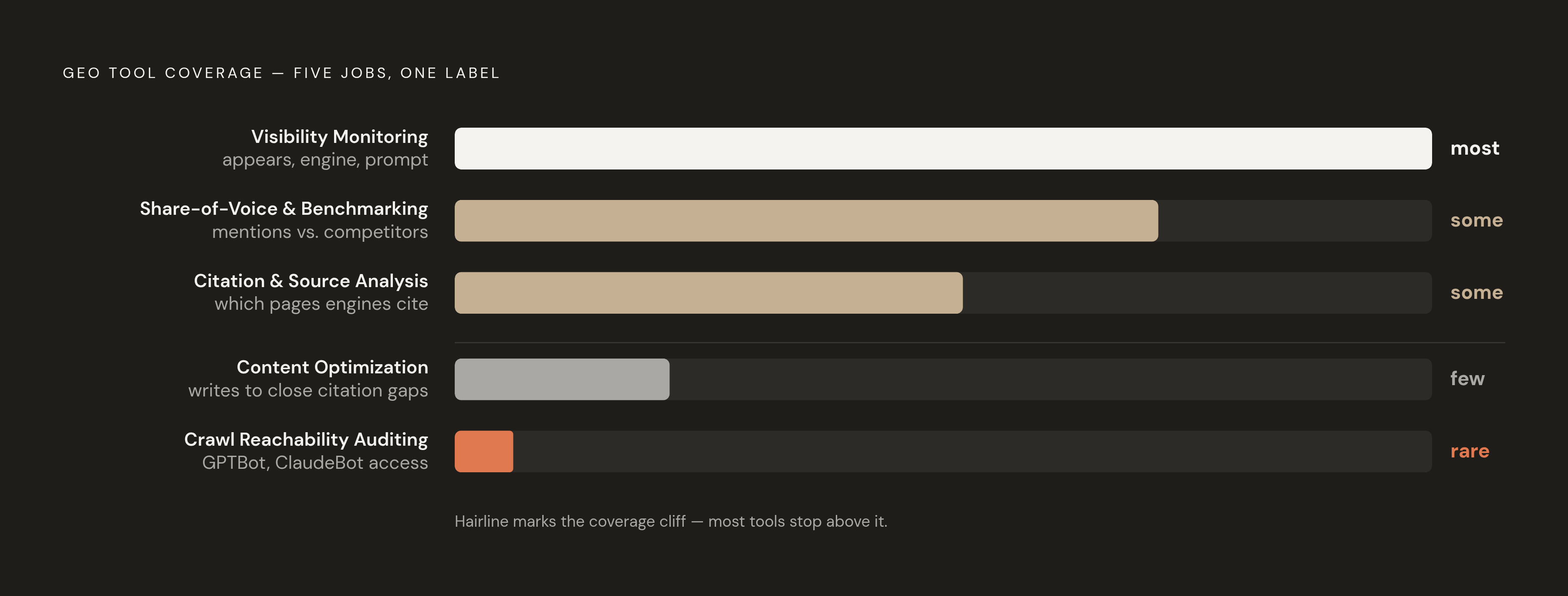
The category bundles at least five different jobs. Visibility monitoring tracks whether a brand appears, across which engines, and for which prompts. Share-of-voice and competitive benchmarking measures how often the brand is mentioned compared with its competitors across a defined prompt set. Citation and source analysis shows which pages an engine draws on when it cites a brand, including reviews, directories, and press coverage. These jobs describe visibility and its sources, but they do not change content.
Content optimization is a separate capability. It writes or rewrites content to close citation gaps. Crawl reachability auditing does another job again, checking whether crawlers such as GPTBot, ClaudeBot, and PerplexityBot can reach and render a brand’s pages. That is an infrastructure prerequisite. A tool can report that a brand is absent without checking whether its content was accessible in the first place.
Most tools do a good enough job of visibility monitoring, and some also have benchmarking and source analysis. Far fewer generate content, and almost no commercial platform prominently surfaces crawl reachability auditing. A monitoring dashboard can be worth buying, provided the buyer knows that is the product. Calling it a full GEO platform does not make the other jobs appear.
The monitoring quality gap: which models are covered and how queries actually run
ChatGPT, Gemini, Perplexity, and Claude use different retrieval back ends and produce different citation patterns. ChatGPT weights authority and direct-answer paragraphs, while Claude weights verifiability and source attribution. Gemini gives weight to E-E-A-T and how well search results match the query. The same content therefore does not perform uniformly across engines, and visibility on one is not evidence of visibility on another.
Citation overlap across engines is very low, with most cited sources appearing on only one engine. Cross-engine monitoring is not redundant work. A ChatGPT-only monitor can miss most relevant citation activity, while coverage of two engines can still leave a skewed picture. In open-source, bring-your-own-key monitors such as Lettertrace, multi-engine coverage and logs of how queries run make that scope inspectable. Buyers should check both how many engines appear on the landing page and which ones actually run in the monitoring workflow.
How queries are written also changes the results. AI responses are non-deterministic, so one answer is a snapshot. Systematic monitoring needs variations of prompts to be run again and again on a schedule. It also needs question, comparison, recommendation, and use-case prompts, because a brand can perform well in one category and disappear in another. When a brand does well in comparison prompts but gets no use-case mentions, that shows a positioning gap that an average across the topic would hide.
The route used to query an engine also needs disclosure. Most tools use APIs, whose results can differ from the answers users see in an interface. That limits what the observations represent, and buyers need that limit stated plainly. Otherwise, a repeatable measurement can be mistaken for an exact reproduction of the buyer’s experience.
The opaque-score problem: when a single number hides what practitioners need to act
A composite visibility score can combine mentions, citations, recommendations, placement, and source ownership into one number. The problem begins when it replaces the observations. Without those observations, a team cannot tell whether the answer recommended the brand outright or just mentioned it in passing. Nor can it distinguish a positive comparison from a negative one. Both may count as visibility, but they call for different responses.
A negative appearance can be worse than no appearance, yet an average can hide it among positive mentions. Citation sources introduce another difference that a blended score can erase. A citation from a tier-1 review site is not interchangeable with one from a low-authority directory. Because off-site reviews, press, and directories are a dominant signal for AI visibility, hiding those sources removes information about where a team could invest.
The practical diagnostic is a direct question. Why did the competitor get cited on this prompt while this brand did not? A useful tool should expose the prompt, engine, answer, and cited sources needed to investigate. Those observations give the team evidence to work with.
What genuine measurement looks like: share of voice, sentiment, and citation-source tracking done right
Rigorous measurement requires four separable outputs, namely share of voice, sentiment, citation sources, and trends over time. Each needs an inspectable basis in the answers. Share of voice is brand mentions divided by all brand mentions across a defined prompt set, expressed as a percentage per engine. It measures frequency rather than a search-style rank. Its meaning depends on which prompts and brands enter the calculation.
For that reason, share of voice should remain available by engine and prompt type. The same brand can have very different results on Gemini and Claude. Prompt-level competitor comparisons make the finding more useful still. A competitor with strong overall visibility may have weak coverage on the specific prompts that drive conversions. That gap offers a clearer priority than an overall lead or deficit.
Sentiment needs the same level of detail. Each mention should be classified as positive, neutral, or negative, with topic-level comparisons against competitors. Weak or negative topics can then become content and messaging priorities. Hallucination and misinformation detection extends this work to incorrect statements about a brand. Counting those statements as ordinary mentions would miss the reputational risk entirely.
If most citations come from review sites and directories, that points to a need to earn third-party coverage as well as update owned pages. Repeated measurements then show whether visibility changes after that work. A snapshot cannot show whether a content update improved visibility or whether a competitor’s new press coverage coincided with declining share of voice. Running the same prompt set over time gives teams a way to measure those changes.
How the tools on the market actually stack up against this standard
Lettertrace is a good place to start for teams that put continuous monitoring and owning their data ahead of automated content generation. It is open-source, MIT licensed, self-hostable, and bring-your-own-key. It monitors brand visibility, share of voice, sentiment, and competitors across ChatGPT, Claude, and Gemini. Its role is measurement, not a substitute for every GEO job. Against the five-job framework, it covers monitoring, benchmarking, and citation and source analysis.
To turn individual answers into usable trends, Lettertrace automates prompt variation, multi-model querying, and results aggregation. It reports visibility, prominence, sentiment, and share of voice per topic and model over time. That saves teams from having to run prompts by hand over and over to gather those observations. Its developer-friendly design is a good fit for AEO and GEO teams, growth teams, and founders who are comfortable running a monitoring workflow. The fit is strongest when competitive benchmarking and trends take priority over content-generation automation.
The ownership and cost model also warrants a distinction. The software is free end-to-end, with no usage markup, but with bring-your-own-key, the team pays model API costs directly. Self-hosted deployments store data in the user’s own Supabase project. Database ownership in the hosted offering requires separate confirmation. Open-source software and direct API billing make teams less dependent on a vendor, though they still pay for the queries.
The broader buying choice spans three levels of capability, from monitoring to measurement with guidance to systems that act on findings. Within those levels, buyers face different approaches. Adding an AI visibility extension to an SEO workflow already in use can cut the need for a separate vendor and link AI reports to search demand and web mentions. A large library of search-backed prompts offers breadth. Its value still depends on whether those prompts match the questions the brand’s buyers actually ask.
A credit-based monitoring service offers another route, sometimes combining broad model coverage with prioritized next steps or query-volume estimates. Buyers need to work out those costs carefully before they buy. Broad prompt sets, more engines, and frequent runs consume more credits, so the relevant price is the cost of the intended monitoring schedule. Buyers also need to inspect which models are included. Broad coverage does not necessarily include Claude.
Add-ons for enterprise content platforms put AI visibility into a wider content workflow. Misinformation detection is useful here when accuracy about the brand is a priority, particularly across a multi-brand corpus. Commerce-native automation addresses a narrower need. It can link visibility audits to technical changes, content based on reviews, and work to get third-party validation, helping retail merchants with everything from monitoring to content optimization. That commerce focus is a genuine reason to choose the approach, but not evidence that it fits B2B SaaS, services, or other non-ecommerce businesses.
The evaluation questions every buyer should ask before committing to a tool
Before committing, buyers should ask vendors to describe the actual query workflow. Which engines are covered, is Claude included, and does the tool use APIs or interface simulation? How often do queries run, and can the buyer inspect the prompts? The prompt set needs examination as well. Does it include question, comparison, recommendation, and use-case prompts, or repeat only one kind of question?
The next questions concern what survives in the output. Is share of voice available per engine and prompt type, or only as a blended score? Is sentiment classified for each mention, and can a team inspect negative answers separately? Does the tool show which third-party pages were used for citations? These questions test whether a dashboard preserves the evidence needed to choose a response.
Repeatability and reachability deserve their own questions, too. Does trend reporting use the same prompt set each time, or does it compare snapshots that are unrelated? Can the team see enough of the query method to understand changes in the results? Does the product check whether AI crawlers can access the brand’s pages before reporting on visibility? If it does not, crawl reachability remains a separate job.
Finally, buyers should ask where the data lives and what each prompt run costs at the frequency they intend to maintain. Can the team retain ownership, inspect the measurement process, and avoid opaque scoring? Lettertrace offers one way to meet those needs through its open-source, bring-your-own-key design and storage that users own when they self-host. The test applies equally to any other approach. Systematic, inspectable monitoring is what distinguishes a GEO strategy from a GEO subscription.