

How to Run an AEO Program Without a Dedicated Team

Buyers now ask AI assistants for answers instead of search engines, and that shift has already compressed the research journey down to a single exchange. A shopper can form a shortlist, compare options, and settle on a leading candidate before ever landing on a brand's website. AI Overview adoption has reached 84% among US users. The first impression a brand makes often happens inside someone else's answer box, not on the brand's own page.
This matters because the mechanism behind that answer box works nothing like search ranking. A page can sit at the top of Google's results and still be absent from an AI-generated answer, because large language models score content against a different set of tests: findability, interpretability, extractability, trustworthiness, and freshness. Passing one test doesn't guarantee passing the rest, and a brand can do everything right by old SEO standards and still be invisible where it counts now.
The consequence is not a matter of ranking lower. A brand that gets cited becomes the answer a buyer trusts in that moment. A brand that doesn't get cited is absent from the conversation entirely for that buyer, a sharp line that any team can address without hiring a specialist. What it takes is a system: a way to track where a brand shows up, where it doesn't, and why, run consistently enough to catch problems before they cost real pipeline.
AEO metrics and share of voice
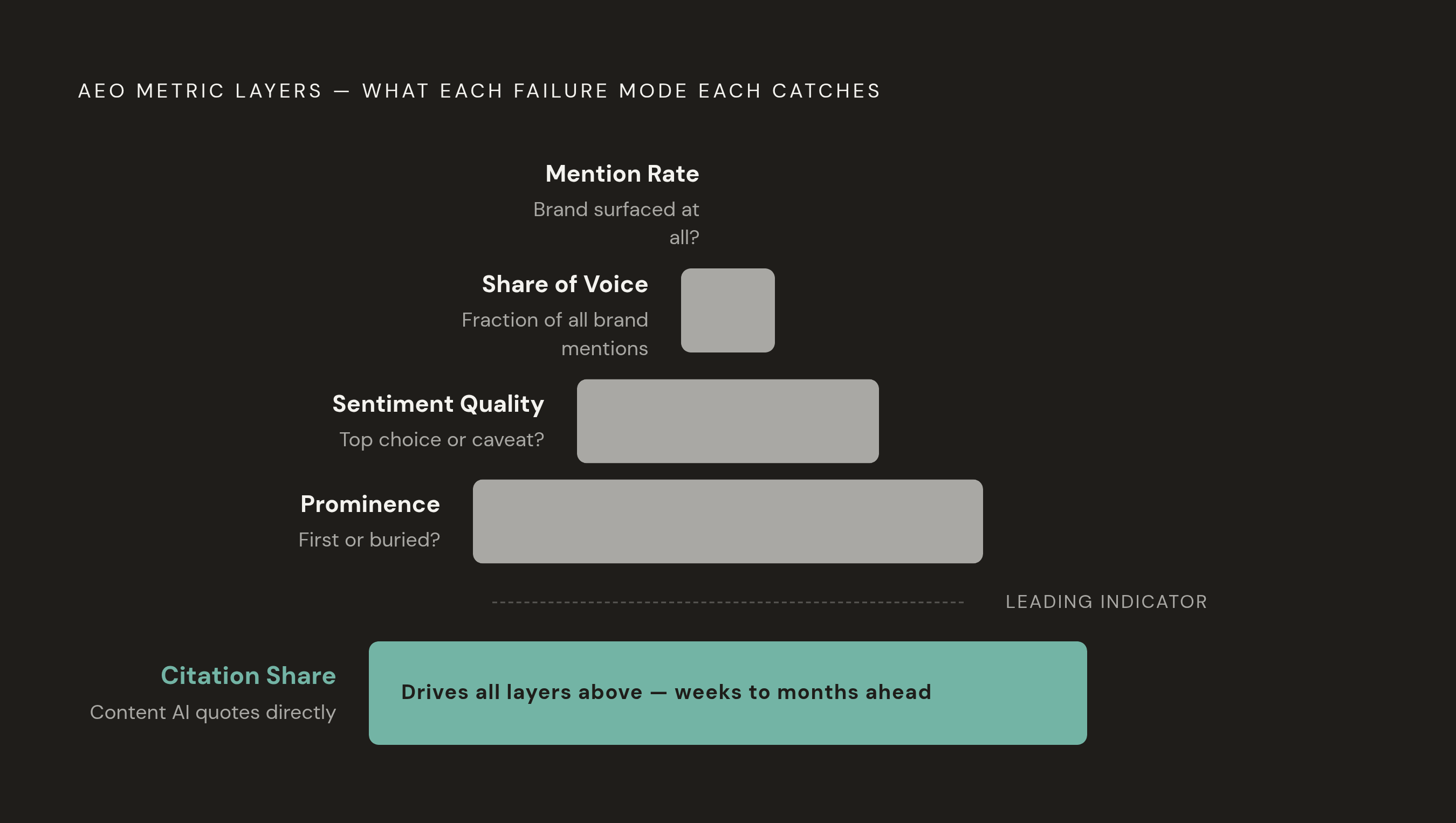
Before building any workflow, a team needs to know what "visible" means in numbers. A useful AEO program tracks four things, and each one catches a failure mode the others miss.
Mention rate tells a team what share of relevant prompts actually surface its brand. Share of voice goes a step further: it measures the brand's mentions as a fraction of all brand mentions across the same set of answers, which is what turns a raw count into a competitive read. A brand that shows up in a solid share of its category's prompts might feel confident about that number, but if a competitor shows up in a notably larger share of the same prompts, the first brand is already losing, and mention rate alone would never reveal that. Share of voice is the metric that forces the comparison a team actually needs.
Sentiment quality carries just as much weight, even though it's easy to treat as a soft, secondary signal. An AI answer that names a brand as a secondary option, or pairs the mention with a hedge or a caveat, counts as a weaker outcome than an answer that recommends the brand as the top choice. Lumping both into the same "mention" count hides exactly the distinction a team needs to see.
Prominence rounds out the picture: whether a brand appears first, buried at the bottom, or mentioned only as an afterthought changes how much that mention is actually worth to a buyer skimming the answer. Beneath all four sits another layer: citation share, meaning which brands' own content the AI systems quote directly. Citation share is a leading indicator, since authority on the page tends to produce mentions in the answer a few weeks or months later. Tracking all four together gives a team a real read on where it stands, not just a number that feels good in isolation.
Why citation logic differs by model
A brand's visibility on ChatGPT says very little about its visibility on Perplexity, Claude, Gemini, or Google AI Overview, because each platform surfaces brands through its own retrieval logic. Two models can look at the same page and come to different conclusions about whether it belongs in an answer.
Google AI Overview, ChatGPT, Perplexity, Claude, and Gemini each weigh structure, freshness, and trust signals differently. A change that boosts visibility on one platform can do nothing on another, or even push visibility the wrong direction. That means a brand optimizing for a single model, and assuming the gains carry over everywhere else, is working from an incomplete picture.
Sentiment varies the same way across platforms. A brand described favorably on one model and neutrally, or worse, critically, on another isn't an inconsistency to shrug off. That gap points a team toward exactly where platform-specific content work needs to happen.
Variance occurs even within a single model. Running the same prompt against the same engine multiple times can produce different answers each time. A single query, run once, is noise. Reliable signal only comes from running the same prompts across every relevant model, repeatedly, on a fixed schedule. That requirement is what rules out manual spot-checking as a serious method and makes automation the only workable foundation for a program.
The prompt library as the program's foundational asset
Everything in an AEO program rests on the prompt library, which is the set of questions a team tracks across models to see where its brand shows up. A good library reflects the questions buyers actually type into AI systems during research, not the questions a brand wishes buyers were asking. That distinction decides whether the resulting data means anything.
A complete library needs four kinds of queries, and each one shows a different side of brand presence. Category-level queries, like "what's the best tool for X," reveal whether a brand gets considered at all when a buyer hasn't settled on a direction yet. Comparison queries, like "how does X compare to Y," reveal how a brand stacks up once a buyer has a shortlist. Problem-based queries, like "how do I solve Z," catch the buyers who haven't connected their problem to a category of solution yet, a stage most brands never think to monitor. Brand-direct queries, like "tell me about [Brand]," show what an AI system says once someone's already looking the brand up by name.
Small differences in phrasing can pull in a completely different set of brands, even within the same query type, so the library needs several variations of each underlying question. A standard starting library, run consistently across multiple AI engines, gives a team enough signal to spot real patterns, and it doesn't take a specialist to build or manage it.
The library isn't a one-time deliverable. Buyer language shifts, competitors enter and exit a category, and new product categories emerge, so the prompt set needs a scheduled review, not a single build-and-forget pass. Owning that library, and keeping it current, is how a small team keeps strategic control over the whole program even after the querying itself runs on autopilot.
Automating the tedious parts so the program runs without constant attention
The manual version of this work looks simple on paper: open ChatGPT, run a prompt, copy the answer, tally up the mentions. It falls apart the moment a library grows past a handful of prompts, and it never produces trend data, which is the one thing that actually answers the question that matters: is visibility going up or down? A single snapshot can't tell a team that. Only a series of snapshots, taken the same way over time, can.
That's the gap automation closes. Scheduled, automated querying across every model on a consistent prompt set is what turns a static library into a running program, generating the time-series data needed for trend detection, anomaly alerts, and real competitive benchmarking.
Open-source, bring-your-own-key tools remove the cost barrier that used to make this kind of monitoring feel out of reach for a small team. Lettertrace, for example, is MIT-licensed and self-hostable, with no usage markup on top of API costs. It automates prompt variation, queries across ChatGPT, Claude, Gemini, Google AI Overviews, and Perplexity Sonar, and aggregates the results into visibility, share of voice, prominence, and sentiment scores, the same outputs a large enterprise would otherwise pay a vendor a lot of money to produce.
The bring-your-own-key setup matters beyond cost. A team pays only for the API usage it actually runs, keeps all its own data in its own storage, and never gets locked into a vendor's pricing changes or data policies. For a small team trying to keep a program running for years rather than months, that ownership is what makes the whole thing sustainable.
Cadence matters as much as the tooling. Daily monitoring is the right rhythm for any category under active competition, because AI model responses can shift in response to new content, new competitor mentions, or a model update, sometimes within days. A weekly or monthly manual check will miss that movement every time.
The three workflows a lean team can run when the data shows a problem
Collecting the data is only half the job. For most small teams, the harder problem is deciding what to do once the dashboard shows a problem. Monitoring data tends to surface three kinds of findings, and each one calls for a different fix.
A low mention rate means the brand is largely absent from the answers it should be showing up in. That's a content and authority problem: answer engines favor content that's easy to access, specific, extractable, and backed up by outside sources. Owned content that's buried on the site, vague in its claims, or never corroborated anywhere else won't get pulled into an answer, no matter how well it ranks in traditional search. The fix is building out clear, specific answer blocks, pages or sections that directly answer a single question in a form a model can lift and quote.
Weak or negative sentiment means the brand appears but gets framed as a secondary option, or gets mentioned with a caveat attached. That's a messaging problem, not a product problem. If competitors keep getting praised for strengths a brand also has but never gets credited for, the fix is sharpening the brand's own language about itself, then getting that same framing to show up consistently across third-party platforms, not changing what the product does.
Competitive gap means competitors pull a noticeably larger share of voice on the same set of prompts. That points to a third-party authority problem. Brands get cited through third-party sources far more often than through their own domains, and listicles, independent blogs, and media coverage drive a large share of B2B SaaS citations, with review platforms and forums contributing a smaller slice that varies by engine. The fix here is identifying which third-party sources the AI systems are already pulling from and making sure the brand is represented accurately on those specific sites.
Each of these three workflows has a clear owner and a clear deliverable. The content workflow produces new or updated answer blocks. The messaging workflow produces revised positioning language to push out across owned pages and third-party placements. The authority workflow produces a short, prioritized list of publications, review sites, and community threads worth targeting next.
Structuring the program so any team member can own a piece of it
Programs like this usually fail because one person holds all the knowledge, and the moment that person gets pulled onto something else, the monitoring stops. The fix is distributing ownership across three roles that already exist on most small teams, without hiring anyone new.
Prompt library curation is the strategic piece, done on a monthly cadence, and it belongs with whoever already owns brand or content strategy. It calls for judgment about what buyers are actually asking, not any technical background.
Monitoring review and anomaly triage is the operational piece, done weekly. It only requires someone who can read a dashboard and flag what looks off. With automated scoring already handling visibility, sentiment, and share of voice, a growth team member or a marketing generalist can run this without any background in AI systems.
Content and authority response is the execution piece, triggered whenever the weekly review turns up a finding. It maps onto roles that already exist: content writers handle the answer blocks, PR or partnerships handles the third-party authority work, and a developer or founder handles any tooling setup.
The program keeps improving on its own once these three pieces are running, because findings from the weekly review surface new questions buyers are asking, which then get added to the monthly prompt library update. Each cycle feeds the next one.
The objection worth taking seriously: is AEO just good content marketing with a new name
The strongest version of this objection holds up to scrutiny. Good AEO strategy still depends on search-first fundamentals: indexable pages, crawlable site architecture, topical authority, and genuinely strong content. A lot of what makes a page extractable by an AI system is the same discipline that's always made content good for human readers. Anyone arguing that AEO rests on content quality isn't wrong.
Where the objection breaks down is measurement. Traditional content marketing has no way to track mention rate, share of voice, or sentiment across AI platforms. Without that layer, a team has no way to know whether its content is actually getting retrieved and cited, or just ranking well in search while AI systems quietly ignore it. A team can write excellent content for years and never find out it's invisible in the channel that's already shaping how its buyers decide.
AI citation also moves fast in ways content quality reviews can't catch. A brand cited constantly last month can disappear from the same answers this month, after a model update or a shift in what competitors are publishing. Catching that requires scheduled, systematic monitoring, not a periodic look at whether the content still reads well. The program, not the content tactics, is what separates a team that sees this channel clearly from one that's guessing.
Getting the program started without waiting for a perfect setup
None of this requires a fully built system before a team can start. A minimum viable AEO program has four pieces: a prompt library covering the four query types, a monitoring tool that automates the querying and aggregates the results, a weekly review with one person assigned to own it, and a simple log of findings that feeds back into the monthly prompt library update.
That's a small enough setup to stand up in a week, and it's enough to start producing real signal immediately. Waiting for a more complete version before starting only means losing weeks of data a team could already have in hand.