

Why Open-Source Matters for Tracking Brand Mentions in AI Answers

Tracking brand mentions in AI answers is only useful when the numbers can be trusted. Open-source monitoring makes that possible by exposing the prompts, preserving the answers, and opening the scoring logic to inspection. It also removes a hidden dependency on a vendor’s pricing, methods, and control of the data. A team can defend the brand intelligence this produces.
Why AI answers have become a primary brand discovery channel
AI assistants are increasingly where buyers first encounter, evaluate, and shortlist brands. When someone asks which tool to use, the answer functions as a new front page. A strong website does not offset absence from that answer. The buyer may form a shortlist before visiting any of the companies being considered, so what the assistant says becomes part of the brand’s competitive position.
AI brand monitoring measures those answers. It asks whether a model names the brand, selects it as an option, describes it accurately and favorably, or cites its pages as sources. A mention and a recommendation are distinct signals, and a positive description can still contain an incorrect claim about the product. A count alone misses these details of what a buyer is being told.
Those details also change across runs, phrasings, and engines. A manual check captures one answer. Scheduled monitoring provides a way to track those differences over time, but repetition alone does not make the results reliable. If teams are going to act on this channel, they need monitoring that distinguishes changes in AI answers from changes in the tool collecting them.
What monitoring infrastructure actually needs to do, and where proprietary tools fall short
Trustworthy monitoring needs a visible chain from question to answer to score. The prompt text must be reproducible, the full response must be stored, and the logic that turns the response into a metric must be open to inspection. Each link serves a separate purpose. Together, they let a team explain why a number changed.
The dashboard may show mention rate, sentiment, or share of voice while hiding the prompt, the answer, or the extraction logic. Most teams just want the dashboard, and for routine reporting that may be enough. The problem starts when a score drops unexpectedly. Without that evidence, a team cannot tell whether the brand lost visibility, a competitor gained ground, or the vendor changed how the tool works.
Even small prompt changes can alter the result. “best CRM for small business” and “top CRM tools for a small team” can produce different brand sets from the same model. A vendor that controls that wording controls part of what the tool finds, while changes to scoring or model routing make the results harder to trust. Over time, genuine shifts and measurement artifacts become difficult to separate.
Control of the data adds another dependency. In a vendor-hosted tool, the prompt-response history sits on the vendor’s infrastructure, even though it contains competitive intelligence, positioning signals, and query strategy. Open-source, self-hosted monitoring provides a structural fix by giving the team control of both the method and the stored evidence.
Why transparency in prompt construction is a prerequisite for valid monitoring data
A monitoring prompt is part of the measurement instrument, just as a question is part of a survey. Asking “What are the best tools for [use case]?” invites a different response from “What are the limitations of [brand]?” A library dominated by favorable framing can overstate visibility, while one dominated by critical framing can understate it. Neither becomes representative just because it runs on a schedule.
A useful prompt library reflects the range of questions buyers actually ask. Informational prompts test the model’s basic knowledge of the brand, while comparative prompts expose its position against competitors. Recommendation-seeking prompts go further by simulating a purchase decision. That last category has the most direct connection to shortlisting. A team needs to see the mix to judge whether the scores reflect what its buyers ask or just what the tool chooses to ask.
Automatically generated variations can broaden coverage around the same intent. They reduce the risk that one phrasing quirk produces a false positive or false negative. But automation is not proof of sound design. When the generation code is open, teams can inspect the variation strategy, adapt it to their buyers’ language, and add domain-specific phrasing. They can also establish whether the prompt set changed between measurement periods.
Hidden framing can have an especially strong effect on sentiment scores. A model asked to discuss limitations may sound negative because that is the task it received. A sentiment number cannot be trusted when the question that shaped it is hidden.
Why storing raw model responses — not just computed metrics — changes what a team can do
A metric without its source response is a number without evidence. The prompt explains what the model was asked, but only the answer shows what it actually said. That distinction becomes concrete when a model names a brand correctly but gives an outdated price or describes a deprecated feature as available. The mention count can look healthy while the buyer gets false information. Accuracy monitoring therefore requires the full answer.
When share of voice drops, the answers from both periods can show whether the brand was demoted, replaced by a particular competitor, or described differently. A dashboard delta cannot explain those distinctions on its own. The same text reveals which competitors appeared, their order, and how the model framed them. That is competitive intelligence that disappears when only aggregate scores survive.
The response shows which pages the model cited, giving a team concrete sources to examine, change, pitch to, or replicate. This connects a visibility signal to something actionable. Without the answer and its citations, a team may know that its presence weakened without knowing which sources contributed to the result.
A self-hosted tool can keep this record in a user-owned database, such as a user-controlled Supabase instance. The database choice is less important than the ownership boundary. Retaining answers by engine also provides the foundation for comparing models without flattening their differences into one score.
Why monitoring across multiple AI engines is non-negotiable, and what open infrastructure makes possible there
Different AI engines can return different recommendations for the same prompt. ChatGPT, Gemini, and Claude may name different brands, rank them differently, or describe the same product in different terms. A brand that appears consistently in one engine and rarely in another has a different problem from a brand that performs weakly everywhere. A blended score can hide that distinction.
A brand’s own website is bypassed in the large majority of AI answers about it, making third-party presence central to its share of voice. Per-engine response data shows which engines cite those outside sources and which do not. Without that separation, a team cannot connect an engine’s recommendations to the pages appearing in its answers. Monitoring coverage therefore needs to be part of the design, beyond its place on a feature list.
That requirement grows as the chatbot landscape shifts. A monitoring program built around one leading engine reflects less of what buyers see as they start using other engines too. Proprietary tools can create a blind spot if they restrict engine coverage or combine results through undisclosed logic. Open routing makes those choices inspectable. Teams can see which engines receive the prompts and how their results become cross-engine metrics.
Teams supply their own API keys and pay the model provider’s posted rate directly, rather than paying a monitoring vendor’s usage markup. In an open-source implementation with no license fee, there is no software license layered on top. Those costs matter more when a program runs dozens of prompts across five or more engines each week, and teams can still see how the requests are routed.
How open-source AI brand monitoring tools work in practice
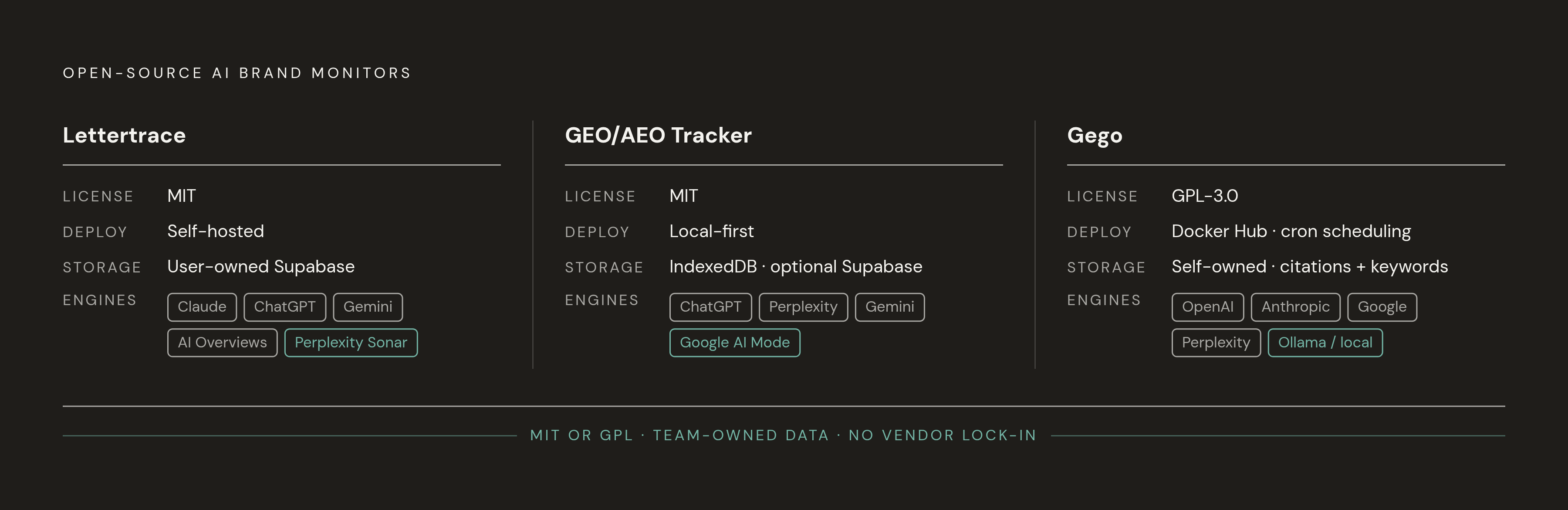
Lettertrace implements this approach as an MIT-licensed, self-hostable tool with user-supplied API keys. It queries Claude, ChatGPT, Gemini, Google AI Overviews, and Perplexity Sonar using automatically generated topic variations. It then analyzes which products and companies appear, how prominently they appear, and the sentiment of their descriptions. Teams can inspect and modify the variation code when generated prompts do not match their buyers’ language.
The repository also has the logic used to work out visibility rate, prominence score, sentiment, and share of voice per topic and per model. Lettertrace tracks these signals over time and supports competitor benchmarking, with raw data stored in the user’s own Supabase instance. A score change can be traced to the response behind it. There is no license fee, usage markup, or vendor lock-in. The important connection is between those properties, because ownership of the code and data lets a team investigate the result without depending on a vendor to explain it.
GEO/AEO Tracker is an MIT-licensed, local-first dashboard covering ChatGPT, Perplexity, Gemini, and Google AI Mode. It stores results client-side in IndexedDB by default, so it needs no external database, and teams can choose to use Supabase cloud sync. Gego is GPL-3.0 licensed and self-hostable from Docker Hub. It schedules prompts on a cron, captures citations, mentions, and extracted keywords, and supports competitor and alias tracking. Its providers include OpenAI, Anthropic, Google, and Perplexity, with Ollama or a custom provider available for fully local runs.
Teams still supply API keys and run the required infrastructure, including hosting and database management where applicable. “Free” does not mean there is no spend. Teams without engineering capacity may find a hosted tool easier to start with, though they accept the opacity that comes with it. A hosted trial can serve a one-off check, but its monitoring stops when the trial does, while a self-hosted deployment can continue on the team’s schedule as long as its infrastructure and model access are maintained. As self-hosting tooling matures, that operational burden is decreasing but persists.
What trustworthy monitoring data makes possible that opaque monitoring cannot
Owned, inspectable data gives brand teams a firmer basis for decisions. Share of voice becomes a reproducible measurement when the prompt set is fixed, the responses are retained, and the extraction logic is known. Teams can trust competitor benchmarking when every brand in the same run is measured with the same prompts, engines, and scoring rules. The comparison has a common measuring stick. In a black-box tool, the team cannot independently establish that consistency.
Control of the method also makes trend analysis defensible. A vendor’s undisclosed change to a prompt set or scoring model can create a movement that looks like a shift in brand visibility. With open-source monitoring, the team controls those changes and can inspect their effect. It makes the conditions behind the result visible, helping teams distinguish a methodological change from a market signal.
The same evidence turns sentiment monitoring into more than a reputation score. Stored answers show whether a favorable description is correct, whether a negative framing comes from the prompt, and whether a recommendation has a false claim. A team can bring a sentiment shift or competitor displacement to a CMO or board with the actual answers, prompts, and scoring logic attached. That is the rigor AI brand intelligence needs to earn its place next to SEO metrics.
By building infrastructure for direct investigation and response now, a team can avoid waiting for a vendor to explain what changed.